How to Scale Social Media With AI: The 2026 Playbook for Small Business and Agencies
Scale social media with AI in 2026: the practical Kubeez playbook for shipping 30+ posts a month across Instagram, TikTok, LinkedIn, Shorts and X.

Modern social algorithms reward content velocity — accounts that ship something useful three to seven times a week beat accounts that disappear for a fortnight and resurface with one polished post. That's not a vibe; it's the 2026 TikTok algorithm weighting a 30-minute view-velocity window over follower count, and it's the Buffer benchmark showing brands now average 5 posts per week on Instagram and TikTok alone, before LinkedIn, YouTube Shorts, and X enter the calendar.
If you're running a small business or an agency, that cadence is the whole problem. You don't lack ideas. You lack the hours to produce, caption, score, edit, and schedule 30+ pieces of content a month, on five platforms, for every brand you serve. This post is the practical playbook for using Kubeez to scale social media without hiring a four-person content team.
#The real benchmark: what content velocity actually looks like in 2026
Before you optimize anything, calibrate against current data. Here is what brands posting to scale actually publish, sourced from Hootsuite 2026 benchmarks, Sprout Social's 2026 strategy report, and HeyOrca:
| Platform | Sustainable 2026 cadence | Notes |
|---|---|---|
| 3–6 posts/week (mix of Reels, carousels, stories) | Quality + variety, not raw volume | |
| TikTok | 3–5 short videos/week, up to 1–2/day for growth | 30-min velocity window decides FYP distribution |
| 2–3 posts/week | Rewards quality and quantity drops fast | |
| YouTube Shorts | 2–4/week | Consistent posters grow subscribers ~67% faster |
| X / Twitter | 1–3 posts/day for business accounts | Algorithmic feed refreshes constantly |
Add it up. A modest, multi-platform brand running Instagram + TikTok + LinkedIn at the low end of every bucket is shipping 8–12 finished pieces of content every week. A small agency serving five clients is producing 40–60.
The old "social media manager" job description was: one person, one calendar, one brand. The 2026 job description is: orchestrator of a multi-format, multi-platform content factory. AI doesn't replace the orchestrator — it replaces the four people who used to be the factory.
#Why scaling breaks without AI (the in-house vs agency math)
The 2026 cost picture, from Sprout Social's pricing breakdown and Feedbird's 2026 guide:
- In-house social media manager: $40,000–$80,000/year base, plus 20–30% loaded cost for benefits and software. Realistic all-in: $55K–$110K per seat.
- Boutique agency retainer: $2,000–$7,500/month — $24K–$90K/year for a small business.
- Tool stack to run it manually: scheduler ($20–$50/mo), design tool ($15–$30/mo), stock library ($15–$30/mo), caption tool, music license, analytics — call it $100–$200/month before any production.
That math is what kills small businesses' social presence. A solo founder cannot personally produce 30 finished posts a month, and the cheapest agency tier is the cost of a part-time employee. The unaffordable middle is exactly where AI content production lives.
#The Kubeez stack, mapped to a weekly content calendar
Kubeez replaces the four-person factory — image production, video production, ad copy, music, captions — with one workspace and one credit pool. Here is what each Kubeez tool produces, and where it lives in a week of social output:
- Image generation — square (1:1) feed posts, vertical (9:16) Reels/TikTok thumbnails, horizontal (16:9) LinkedIn covers and YouTube Shorts end-cards. Default to
gpt-image-2ornano-banana-2for editorial brand-quality stills; see the GPT Image 2 prompt guide for marketers. - Video generation — 5–15 second hook videos for Reels, TikTok, and Shorts. Use Seedance 2 Fast for batch drafts (cost-aware), Seedance 2 or Veo 3.1 when a client wants flagship cinematic quality.
- Ad copy generator — primary headline, three short variants, hook, body, and CTA per post. Use it for caption packs by feeding the same brief and asking for "10 caption variants for an Instagram Reel about X."
- Auto Captions — word-by-word styled subtitles for vertical Reels/TikTok/Shorts. The single fastest engagement lift on short-form video and a non-negotiable in 2026.
- AI music generation — original tracks per video, up to 8 minutes per track, no licensing headaches. Match the BPM to the post mood instead of fighting copyrighted audio.
- Dialogue / voiceover — branded narration in a chosen voice or a cloned voice for the brand owner who wants their own delivery on every reel.
- MCP — chat-style automation. Tell the connected assistant "generate 20 Instagram plate-ups for an Italian bakery, then write 20 matching captions, then add background music to the 5 best for Reels" and it fans out the calls, polls each job, and hands back permanent CDN URLs.
That stack is the difference between writing a content calendar and executing one.
#A week of social content in one afternoon (concrete recipe)
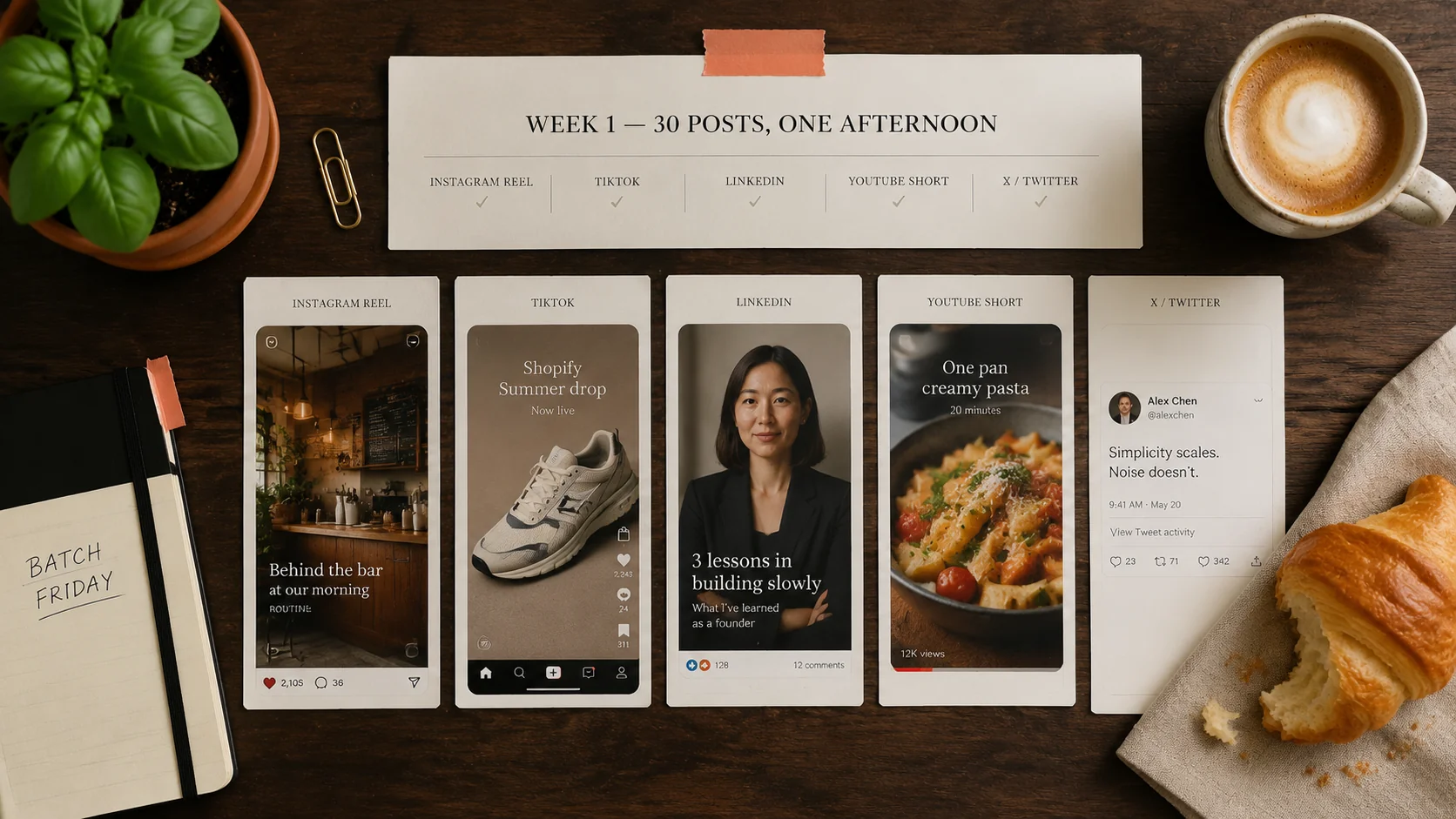
This is the workflow that lets one operator run a brand. Time-budget: 3–4 hours, once a week, total output: 12–18 finished posts across IG, TikTok, LinkedIn, and Shorts.
#Step 1 — Set the week's themes (15 minutes)
Open a doc. Write down the brand's three pillars (e.g. for a local bakery: behind-the-counter, new-bake-of-the-week, customer reactions). Map them to the week's platforms:
- Mon: Instagram Reel — behind-the-counter
- Tue: TikTok — new-bake of the week
- Wed: LinkedIn — owner's note on small-batch sourcing
- Thu: YouTube Short — 30-second customer reaction montage
- Fri: X thread — three-tweet story of the week's bestseller
- Sat: Instagram carousel — 8 swipeable photos of the new menu
That's six posts. Three more themed variants give you 9. A second pass adds Stories. You're at 12–18 without trying.
#Step 2 — Batch-generate images (45 minutes)
Open Images on Kubeez. For each post slot needing a still, draft one creative-director prompt:
"Editorial bakery photography, soft north-window daylight, golden sourdough loaf on a dark linen surface, flour dusting, hands tearing the crust, 50mm shallow depth of field, magazine style. 1:1."
Run it once at standard 1K resolution on gpt-image-2 or nano-banana-2. Three variants per slot. Pick the best one. 18 images at standard resolution costs about 200 credits and takes one cup of coffee.
#Step 3 — Animate the strongest stills (1 hour)
Pick the four to six images that will work as Reels/TikTok/Shorts hooks. Feed each into Seedance 2 Fast as image-to-video at 480p or 720p, 5–8 seconds. Prompt with a clear motion verb ("steam rises from the loaf as hands tear it apart"). Six 6-second 480p clips clear under 600 credits.
For one premium client deliverable per week, run the same prompt through Seedance 2 Standard or Veo 3.1. Compare side-by-side — the difference per post will tell you which clients deserve the upgrade.
#Step 4 — Captions, music, voiceovers (30 minutes)
- Captions on every vertical video — drop the rendered Reel into Auto Captions and pick a word-by-word styled track. Five minutes per video. See the captions deep-dive.
- Background music — one warm acoustic track via AI music generation, used across the week's mood-aligned clips. One generation, eight minutes of audio, looped per video.
- Voiceover (optional) — for one or two of the week's Reels, write a 20-second script and run it through the dialogue endpoint. Saves the owner from filming themselves.
#Step 5 — Caption text + CTAs in bulk (20 minutes)
Open Ad Copy generator. Feed it your three pillars and ask: "Write 12 Instagram captions and 12 TikTok captions for a sourdough bakery, mix curiosity-driven hooks and informational hooks, each with a soft CTA to visit the shop this weekend."
You'll get a usable caption library in one shot. Tweak the top 12, drop the rest. Same workflow for LinkedIn (write more like an essay) and X (write punchier and threadable).
#Step 6 — Schedule and ship (15 minutes)
Drop the finished assets into whatever scheduler the business already uses — Buffer, Later, Metricool, native platform schedulers. Kubeez outputs ship with permanent CDN URLs, so no re-uploads and no compression artifacts.
Total elapsed: under 4 hours. Total Kubeez credits: well under $25 worth at most retail price tiers. You've replaced 30+ hours of in-house production with one focused afternoon.
#The multi-platform repurposing playbook
Producing 12 posts is one problem. Squeezing 30 posts out of those 12 is the next move, and it's where most small operators leave money on the table. Every finished asset should be cut into at least three formats before it ships:
- Vertical 9:16 hero — the original Reel/TikTok/Short. The "headline" version.
- Square 1:1 feed crop — same clip, recomposed at 1:1 for the Instagram feed and LinkedIn. Use KubeezCut to recompose without re-rendering.
- Static carousel — pull 4–8 keyframes from the video, run each through Nano Banana 2 editing if you need a different background or copy variant, ship as an Instagram or LinkedIn carousel.
- Long-form repurpose — string three or four short clips end-to-end into a 60–90-second YouTube Short or a LinkedIn-native video. See long video → shorts with captions.
- Text thread — feed the transcript into the Ad Copy generator and ask for a five-tweet X thread or a LinkedIn post.
One generation, five published posts. That's the velocity multiplier the algorithm actually rewards.
#Scaling beyond solo work: the agency playbook
Once you can run one brand on this stack, the leverage move is running five. The pattern that compounds:
#One workspace, multiple clients
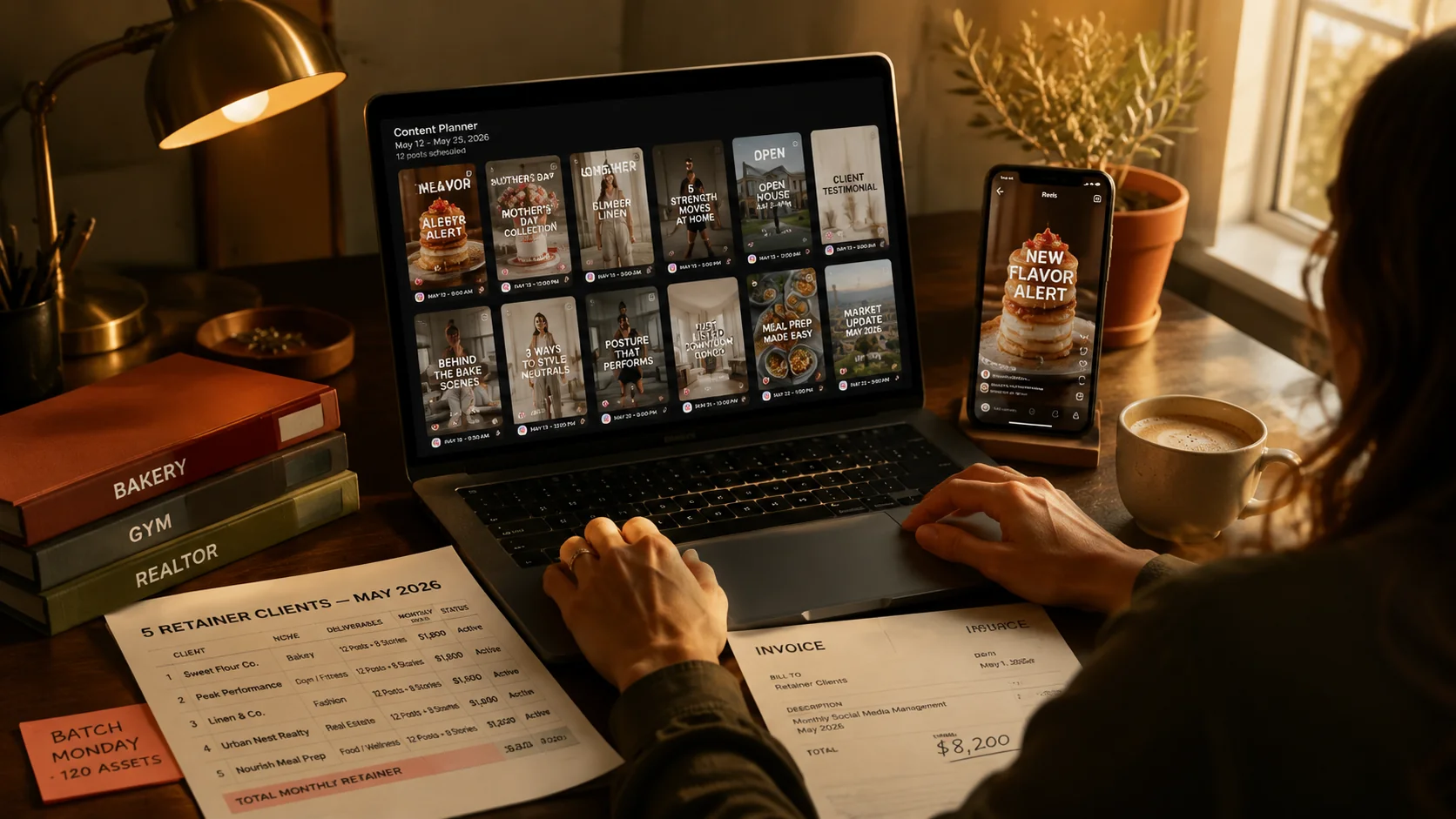
Generate per-client content into a single Kubeez account, organized by week. Permanent CDN URLs let you hand a client a Notion or Drive folder of "week 23 assets" without ever re-uploading. Bill the client $1,500–$3,000/month for the outcome (30 posts, 8 reels, captions, music, copy). Spend ~$30–$60 of Kubeez credits behind the scenes. Margin clears the rest of the business.
#Automate with the MCP-connected assistant
The single biggest unlock for agencies running 3+ retainers is connecting Kubeez via the Model Context Protocol. Once wired in, the assistant accepts plain-English orchestration:
"For Client A (Italian bakery, Mon/Wed/Fri posting), generate 12 Reel-ready 6-second clips at 480p with audio, themed sourdough/croissants/customer-reactions, captioned, plus 12 caption variants. Then do the same for Client B (yoga studio) with serene morning-light themes."
The assistant fans out the calls, polls each generation, and hands back URLs. Two clients, one prompt, ten minutes of operator time. Read the Claude + Kubeez MCP walkthrough for the setup.
#Or build a custom pipeline
For agencies with a developer in-house, the Kubeez REST API lets you wire a generation pipeline directly into a content management system. One weekend of integration, and every Monday turns into a 5-minute trigger that spits out the week's assets per client. See API + MCP automation.
#What clients ask before they pay (FAQ)
Is AI-generated social content allowed on Meta, TikTok, LinkedIn, and YouTube? Yes — Kubeez outputs ship with full commercial rights on standard plans. Each platform has its own AI-disclosure rules for paid ads and political content; the organic content itself is yours to publish. When in doubt, follow each platform's published disclosure policy.
Will posting AI-made content hurt engagement? Only if the content is bad. The 2026 Sprout Social pulse survey found consumers reward quality and consistency, not provenance. The losing strategy is generic, on-brand-only-by-accident AI slop; the winning one is using AI to produce more of the specific, niche, brand-anchored content you'd already wanted to publish.
How much does a month of social cost in Kubeez credits? A reasonable monthly footprint for one brand — 20 photos, 8 reels at 480p, 30 captions, one music track, weekly auto-captions — is well under 1,500 credits. Pricing per model lives in the available models doc. Kubeez does not refund generations, so always pilot a prompt at 1K resolution before committing to 2K or 4K work.
Do I still need a scheduler like Buffer or Later? Yes — Kubeez produces the content; the scheduler handles the publishing and analytics. The two stack neatly. Most schedulers accept a direct CDN URL paste, so handoff is one click per post.
Can a solo founder really run this without hiring? Yes for one brand at a few-hours-per-week budget; honestly no past three or four brands without help. Past that, the leverage is hiring one junior content operator to drive the Kubeez workflow under your direction — that person does in 10 hours/week what used to be a 30-hour-a-week job.
What about TikTok's view-velocity window — does AI-content compete? Yes, because the 30-minute window cares about completion rate and early engagement, not how the asset was made. The 4× distribution multiplier for videos watched past 85% rewards short, hook-led, high-completion clips — which is exactly the format AI image-to-video tools produce most reliably.
#TL;DR
- 2026 algorithms reward content velocity: brands posting 3–7 times/week per platform beat brands posting once and disappearing.
- A multi-platform week is 8–12 posts minimum; an agency with 5 retainers is 40–60 posts/week. Manual production at that scale costs $55K–$110K/seat in-house or $2K–$7.5K/month per client at agencies.
- Kubeez compresses image, video, captions, music, dialogue, and ad copy into one workspace and one credit pool. One afternoon a week per brand replaces a four-person content team.
- The repurposing playbook turns 12 generations into 30 published posts: 9:16 hero → 1:1 feed → carousel → long-form Short → text thread.
- For solo operators, run it via Kubeez directly or the MCP assistant. For agencies and developers, wire the REST API into a content pipeline once and trigger the whole week's run with one command.
If you've been told you can't keep up with social, the truth is you couldn't — at manual production speeds. The content factory that used to need four people now fits in one Kubeez account.
See also