AI Video Ads for Small Business: From Zero to High-Converting in 2026
The 2026 workflow for AI video ads small business owners can run in under an hour — script, image, video, captions, music, export — all on Kubeez.
Every benchmark in 2026 says the same thing: short vertical video is now the default format on Meta, TikTok, and YouTube — and small businesses that ship five video creatives a month are quietly out-buying competitors who still post a flat product photo and a price. AI video ads for small business are not an experiment anymore. They are the cheapest way a one-person operation can compete with a brand running an agency on retainer.
This guide is the practical workflow: why the format wins in 2026, what it used to cost (and what it costs now on Kubeez), and the exact end-to-end pipeline — script, image, video, copy, captions, music, export — that produces a high-converting 9:16 ad in under an hour, with no editing skills.
#Why small businesses can't afford to skip video ads in 2026
The platforms have voted with their algorithms. HubSpot's 2026 State of Marketing Report shows that 94% of marketers now plan to use AI in content creation, with short-form video the single most-invested format across surveyed teams (HubSpot). The catch: large enterprises are still roughly twice as likely to use AI as small businesses, which means the SMBs who do adopt now own a closing window of cheap creative leverage.
The performance gap is now an order-of-magnitude story:
- Engagement — video ads on social deliver about 48% higher engagement than static image ads, and display video drives roughly 120% more engagement than static formats (SQ Magazine, Video Explainers).
- Click-through — video CTR averages 1.9% vs. 1.1% for static, with short-form video pulling ~58% higher CTR than static across platforms (SQ Magazine).
- Cost to reach — TikTok CPMs average $4.80–$9.16 in 2026, roughly half of Meta's average ~$14.91 CPM, so a small business with a $300 test budget can buy real impressions on TikTok and learn fast (Lebesgue, Trendtrack).
- Budget reality — the SBA recommends 7–8% of revenue on marketing for businesses under $5M, and benchmark data puts small-business marketing spend at 15.6% of total budget on average (Boomcycle, Mercury).
Translation: a coffee shop pulling $40k/month in revenue should be spending roughly $3k/month on marketing. Putting even half of that into vertical video on TikTok and Reels — at sub-$10 CPMs with ~48% better engagement than static — is now the single highest-leverage play available to a small operator.
#The traditional barriers (and why they fell)
Five years ago, the same coffee shop owner could not have run a video ad campaign without writing one of these checks:
| Line item | Traditional cost (2021) | Reality in 2026 |
|---|---|---|
| Concept + script | $500–$1,500 (copywriter) | Free — written in 10 minutes |
| Shoot day (camera, lights, talent) | $2,000–$6,000 | $0 — generated |
| Editor (cuts + color) | $800–$2,000 | $0 — generated |
| Captions + motion | $200–$500 | $0 — automatic |
| Music license | $50–$300 per track | $0 — original AI music |
| Total per :15 spot | $3,500–$10,000+ | Under $5 in credits |
The agency line for a single :15 hero spot has held at $5,000–$15,000 per finished asset for years. AI video models have collapsed that line into a tool spend a freelancer or owner can absorb in an afternoon. The barrier is no longer money. It is the workflow.
#The Kubeez AI ad creator workflow, end to end
Below is the exact production pipeline. Every step lives inside Kubeez and runs from a browser. No installs, no editing software, no after-effects template marketplace.
#Step 1 — Script the ad in 90 seconds
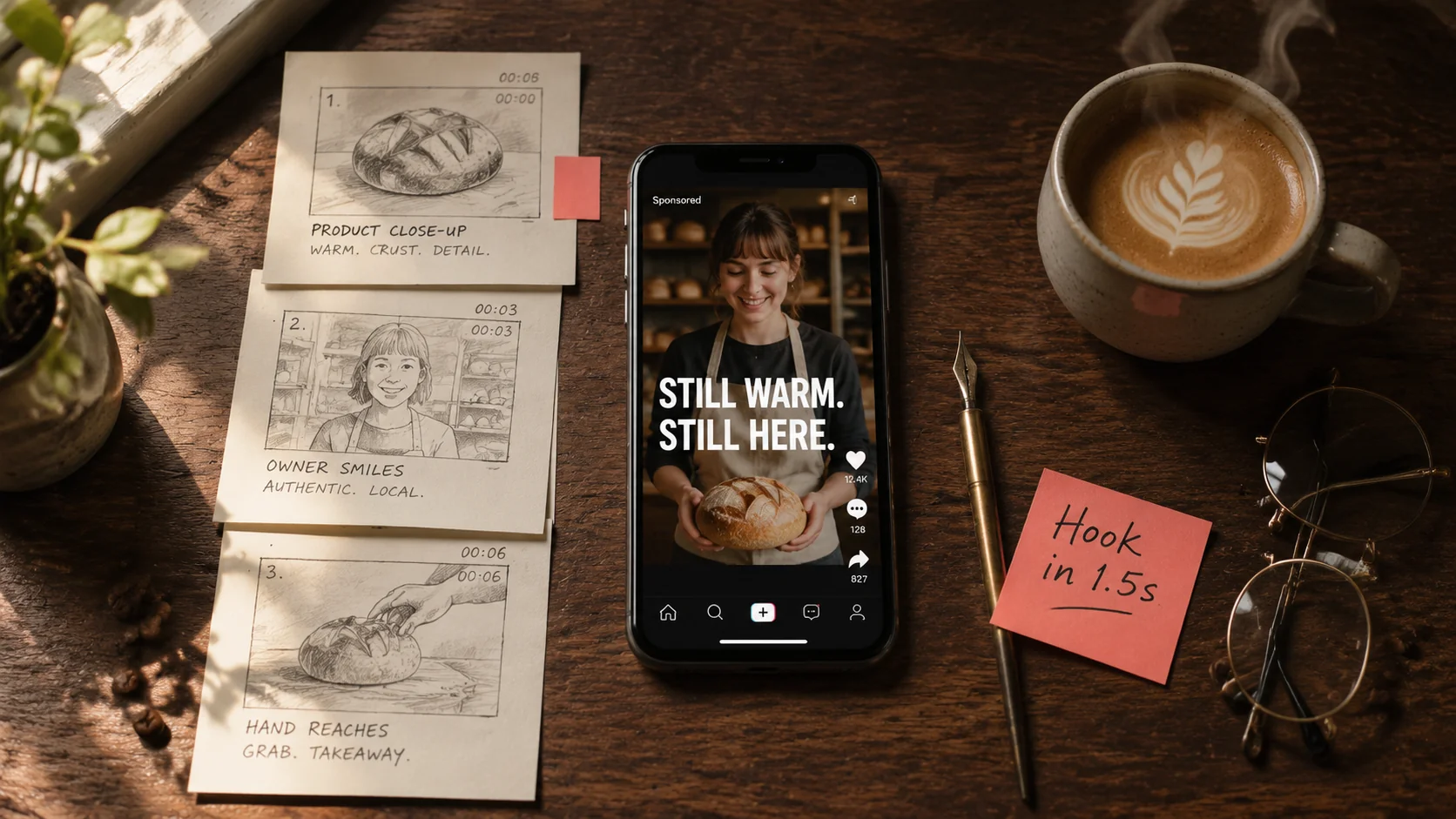
The hook is the only thing that matters. Algorithms decide whether your ad gets distributed in the first 1.5 seconds of viewing time. A workable script for any small business has only four lines:
- Hook (0–1.5s) — a concrete, unexpected, on-brand opener. Show, don't promise.
- Stakes (1.5–4s) — why this matters to the viewer right now.
- Proof (4–10s) — one specific detail (a product close-up, a happy customer frame, a price).
- CTA (10–15s) — one ask, one verb, one place to tap.
Write three different hooks. You will need them for A/B testing.
Kubeez can do the writing for you. Open the Ad Copy generator, paste a one-line product description ("Friday peony bouquets, $42, hand-delivered in Brooklyn"), and it returns the hook, body, captions, and three CTA variants in seconds. That's your script.
#Step 2 — Generate the visuals with the right model
For most small-business ads, you have two paths:
- Photoreal still + animate to video — generate a static image with GPT Image 2 or Nano Banana 2, then animate it. Best for product close-ups, lifestyle scenes, and storefronts where you need a specific scene under your control.
- Text-to-video direct — go straight to motion with Seedance 2 Fast for cost-aware drafts, or Seedance 2 / Veo 3.1 for flagship cinematic quality.
Default for SMB cost-control: generate a strong 9:16 still on GPT Image 2 first, then animate. You can iterate ten variations of a still cheaply, pick the strongest, and only spend video credits on the winner.
A working prompt for a florist ad:
"Vertical 9:16, editorial photography, slow afternoon light, a hand wrapping a bouquet of coral peonies and eucalyptus in brown craft paper, dark walnut counter, blurred florist shop in background, magazine style, 50mm shallow DOF, warm tones, no text overlay."
Generate three variations. Pick the one that hooks you in 1.5 seconds. Animate it on Seedance 2 Fast with a simple motion brief — "subtle hand movement wrapping the bouquet, gentle drift, cinematic" — and you have your hero clip.
#Step 3 — Bake in captions (non-negotiable for 2026)
85% of vertical video is watched with sound off. If your captions are not baked into the visual track, your ad does not exist on a commute. Auto Captions on Kubeez produces word-by-word styled subtitles in seconds — sized, positioned, and animated for vertical feed playback. Pick one of the templated styles (TikTok bold, Instagram Reels minimal, or the high-contrast yellow-on-black for accessibility) and export.
Caption rules that survive every algorithm change:
- One to three words per frame, not full sentences.
- Top-third or center placement — never bottom, where the UI eats it.
- High contrast, sans-serif, no thin weights.
- Punch one word with color or scale (the hook word, not the verb).
#Step 4 — Add original music
Stock music libraries flag your ad as a "stock ad" to viewers in three seconds. Original music doesn't. Open AI music generation, prompt a short cue ("warm acoustic indie, light strumming, 15 seconds, slightly hopeful"), and pick the cleanest take. Tracks can run up to eight minutes; for ads you only need 10–15 seconds.
#Step 5 — Export for Meta, TikTok, and YouTube
Every platform has the same hard rule in 2026: vertical 9:16, MP4, under 60 seconds for the algorithm's favored bucket, captions baked in, hook on frame one. Kubeez exports finished at the resolution you generated; for ads you generally want 1080×1920 minimum. Drop the file straight into Meta Ads Manager, TikTok Ads Manager, or YouTube Shorts upload — no transcoding required.
#The hook playbook (the part that actually decides the campaign)
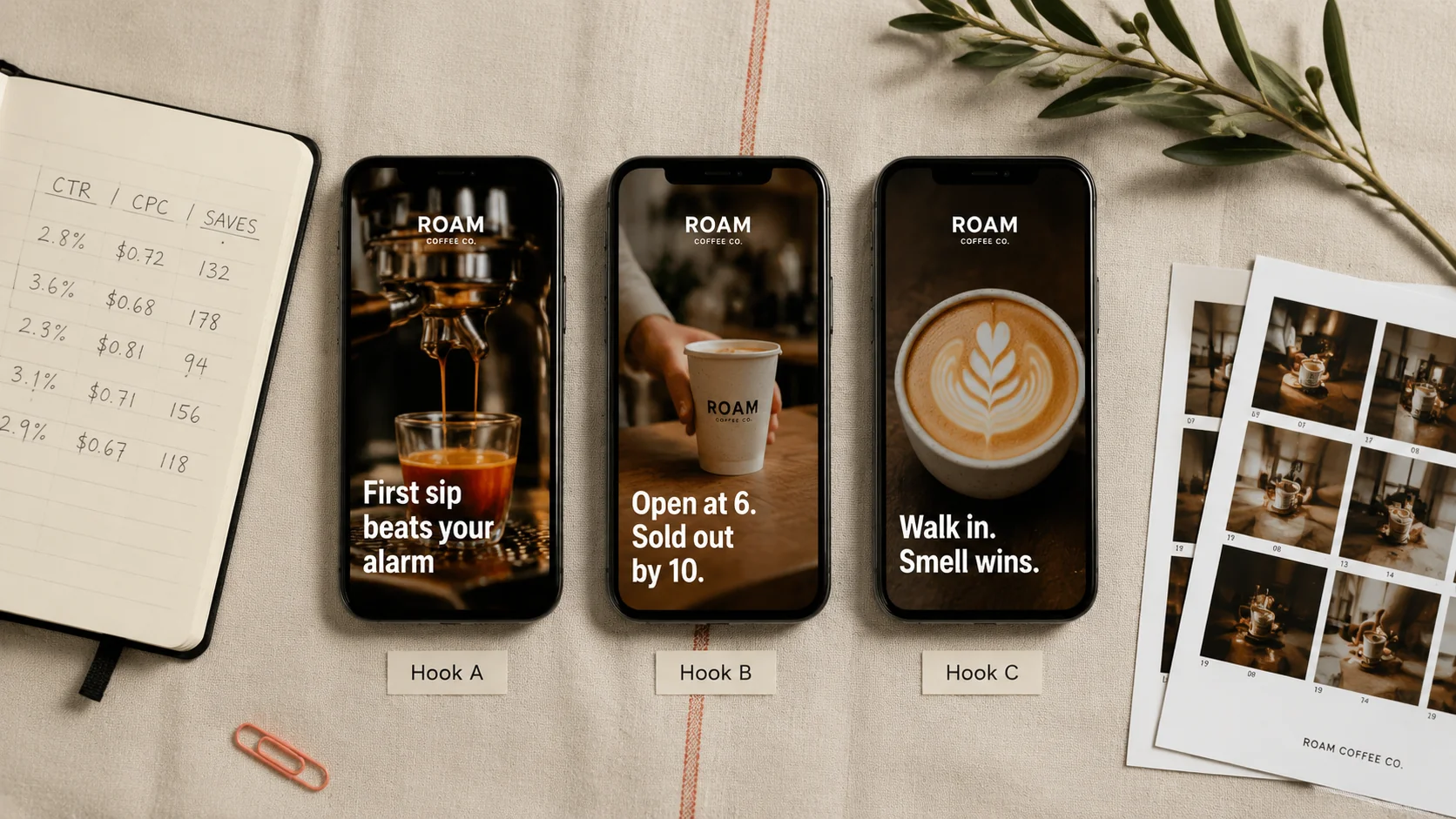
The hook is 80% of an ad's performance. Every working SMB ad in 2026 uses one of five hook archetypes. Pick one per variant and test all five.
- The visceral close-up — extreme close-up of the product doing its job (espresso pull, peony unwrapping, dough being scored). No text for the first beat. Lets the visual carry curiosity.
- The owner direct-address — the owner on camera (real or AI talking head via P-Video) saying one provocative sentence: "We sell out by 10am. Here's why."
- The unexpected fact — caption-led: "$42 buys you the same peonies the Plaza charges $180 for."
- The two-second mini-story — a 2-second narrative arc: empty counter → loaf placed → hand lifting it. Caption: "Still warm."
- The shock-cut contrast — frame 1 grim (empty café), frame 2 alive (Saturday rush). Caption: "Open Saturdays at 6."
Run three variants per archetype, five archetypes, that's 15 ads. Spend $5 per ad in credits to produce. Spend $5 per ad to test on TikTok at $9 CPM. Total: $150 to discover your one winner — which then takes the bulk of your monthly budget.
#A real walkthrough: a Brooklyn florist's first AI video ad campaign
The persona: a florist with a small shop, 1,800 Instagram followers, no marketing team, $1,200/month she's willing to spend.
#Monday — script + visuals
- 30 minutes: brief into Ad Copy. Output: three hooks, three CTAs, a 12-word body.
- 45 minutes: ten still variations on Nano Banana 2 — coral peonies on dark walnut, hand close-ups, shop-window storefront shots, customer holding a finished bouquet. Pick the four strongest.
- 30 minutes: animate the four winning stills on Seedance 2 Fast with motion briefs. Total Kubeez spend: under $20 in credits.
#Tuesday — captions + music + assembly
- Auto Captions on each clip, sized for vertical feed.
- One 15-second warm acoustic music cue, looped where needed.
- Export four 1080×1920 MP4s.
#Wednesday — launch and watch
- Two ads on Meta, two on TikTok, $30/day each platform for three days.
- Three days of CPM data: TikTok pulls at $7.10 CPM, Meta at $13.40 CPM.
- One creative (the visceral close-up of the bouquet unwrap) hits a 4.1% CTR. The others sit at 1.5%.
#Thursday — scale the winner
- Kill the three losers. Push 80% of the remaining budget into the winning creative.
- Generate three more variations of the same hook archetype — different colorways, different captions — to refresh against ad fatigue.
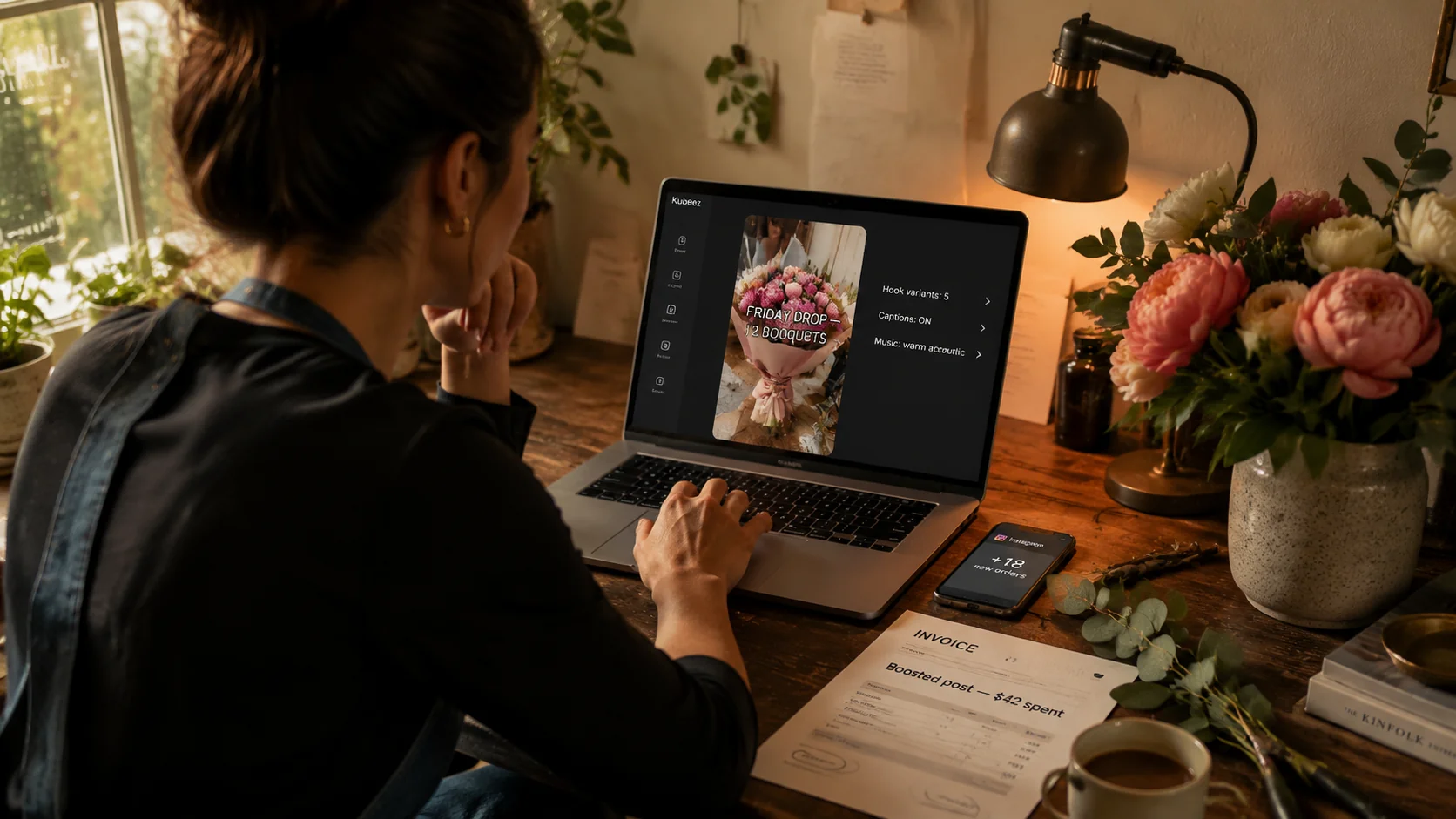
By Sunday the campaign has produced 18 confirmed orders on a $360 spend. That's a $20 CPA on a $42 average order — and the asset cost to produce was effectively zero. The agency quote for the equivalent shoot would have been $4,000–$6,000 for a single :15 spot.
That arithmetic is why every small business that runs paid social in 2026 either ships AI video ads or quietly loses the auction to a competitor who does.
#A few things to actually internalize
- The first frame is the entire ad. No exceptions. If your first frame is a logo or a price, you've lost.
- Captions are not optional. Eight in ten viewers see your ad muted.
- Vertical 9:16 is the default, not square. Square is for organic Instagram feed only, and even there it's a compromise.
- Three to five hooks per campaign. Always. The platform's job is to pick winners; you have to feed it candidates.
- Refresh creative every 7–10 days. Ad fatigue is real. Kubeez makes generating ten new variations a one-hour task, not a one-week production cycle.
#FAQ
Can I use AI-generated video in paid Meta and TikTok ads in 2026? Yes. Both platforms allow AI-generated creative; some require disclosure on certain political or social-issue ad categories, but standard product and service ads are unrestricted. Kubeez outputs ship with full commercial rights on standard plans.
How long should an AI video ad be? For paid social in 2026, 6–15 seconds is the productive range. The platform algorithms favor sub-15s for both completion rate and cost. Longer hero spots (30–60s) are useful for retargeting warm audiences who have already watched the short version.
Do I need a script before I generate visuals? Yes. Generating visuals first, then trying to write copy around them, produces incoherent ads. Write the four-line script first (hook, stakes, proof, CTA), then generate visuals for each beat.
How many credits does a typical 15-second video ad cost on Kubeez? A still on GPT Image 2 or Nano Banana 2 is 11–15 credits. A 5-second Seedance 2 Fast clip is roughly 30–60 credits depending on resolution. Captions and music add modestly. A finished 15-second ad with three image variations and one final video runs well under 200 credits — a tiny fraction of what a single shoot day would cost.
Should I use Veo 3.1 or Seedance 2 Fast? Use Seedance 2 Fast for drafts and most paid ads — it is built for cost-aware iteration. Step up to Veo 3.1 when the campaign is a brand launch, a hero asset, or a campaign that will run for months. See the Seedance 2 Fast announcement and the Veo 3.1 cinematic guide for the full comparison.
Where can I see the full list of supported models and pricing? The available models doc lists every video, image, audio, and ad model with per-generation pricing.
#TL;DR
- AI video ads for small business in 2026 are no longer experimental — short vertical video is the dominant paid format on Meta, TikTok, and YouTube.
- Video ads outperform static by
48% on engagement and$15).58% on short-form CTR, while TikTok CPMs ($9) are roughly half of Meta's ( - The traditional $3,500–$10,000 per-spot agency line collapses to under $5 in Kubeez credits for the finished asset.
- Workflow: script → still on GPT Image 2 → animate on Seedance 2 Fast → bake captions with Auto Captions → score with AI music → export 9:16 MP4.
- Always run 3–5 hook variants per campaign. Hook owns 80% of performance.
- The whole pipeline lives in one Kubeez account, in a browser, with no editing software.
If you run a small business and you have not shipped a single AI video ad yet in 2026, your competitor probably has. The lowest-friction starting point is the Ad Copy generator for the script and Video Generation for the visuals. Pick one product, ship three hooks, spend $90 testing them. Within a week you will know more about what your customers click on than any agency could tell you in a quarter.
See also