AI Marketing ROI: What the 2026 Data Actually Says
AI marketing ROI in 2026: 7 levers where AI delivers measurable ROI, where it underperforms, and the McKinsey/HubSpot/Gartner numbers behind them.
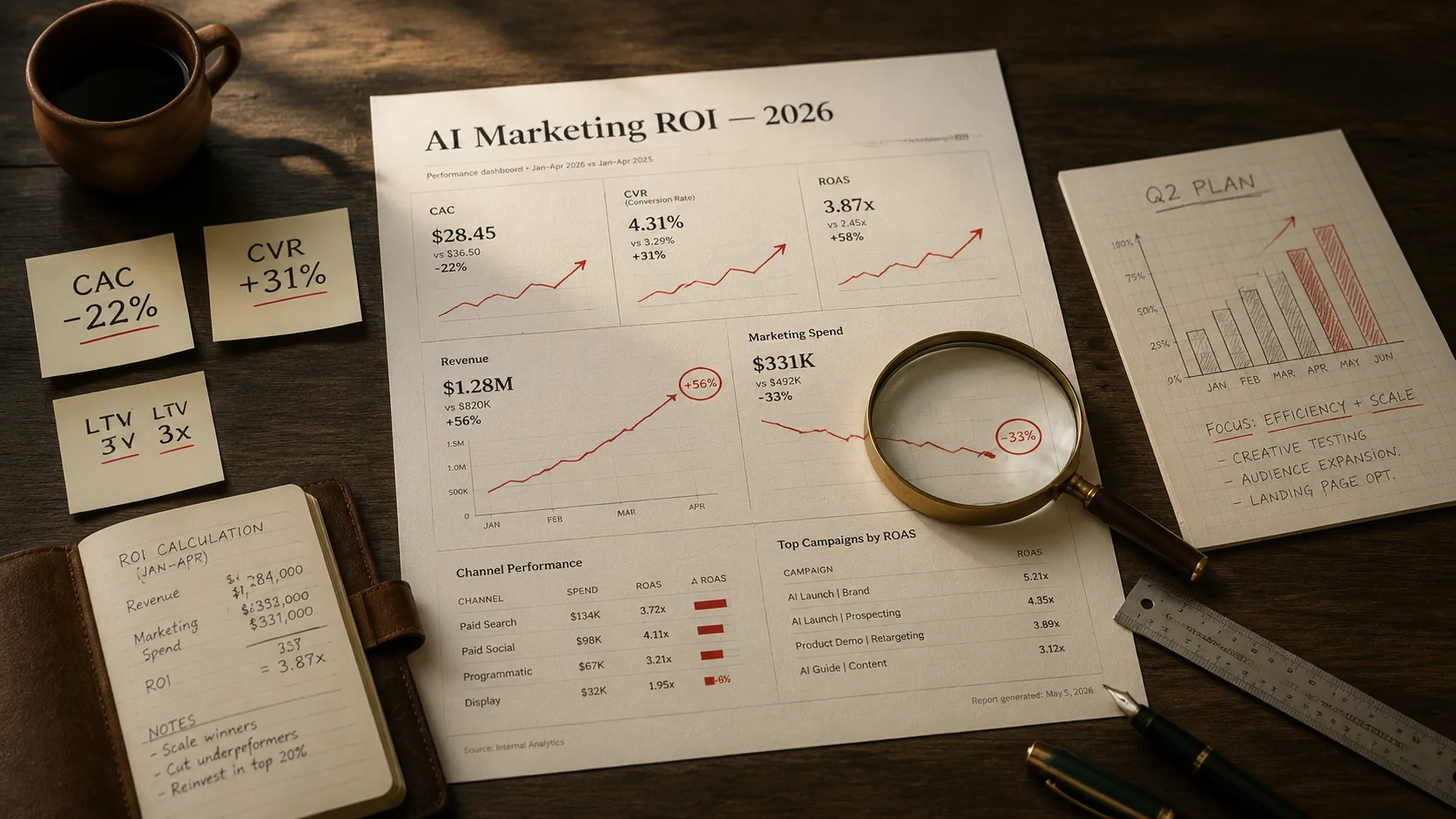
AI marketing ROI is the most over-claimed and under-measured number in the industry right now. Vendor decks promise 10x lifts. CMO town halls quote 35% revenue gains. Then you ask the marketing ops team for the receipts and you get a shrug.
This post is the honest version. We pulled the 2026 primary research — McKinsey's State of AI, the Gartner CMO Spend Survey, HubSpot's State of Marketing 2026, Salesforce's State of Marketing — and separated where AI is delivering measurable ROI from where it's quietly inflating dashboards without moving revenue. No fabricated stats, every number cited.
If you run a brand, a growth team, or an agency, this is the data you can actually take to your CFO.
#The headline numbers (and what they actually mean)
Three numbers will dominate every 2026 AI marketing pitch deck. They're directionally true — and individually misleading without context.
| Number | Source | What it actually means |
|---|---|---|
| 89% of organizations now use AI in at least one business function | McKinsey State of AI 2026 | Adoption is near-universal; competitive moat from "we use AI" is gone |
| 94% of marketers plan to use AI for content creation | HubSpot State of Marketing 2026 | Content is where AI hits first — and where commoditization risk is highest |
| 15.3% of marketing budgets allocated to AI | Gartner CMO Spend Survey 2026 | Budget pressure is real; AI is being funded by reallocating, not by lifting top-line spend |
The honest read: AI adoption is no longer the story. The story in 2026 is the gap between teams that can prove ROI and teams that can't. Per HubSpot, the share of marketers who can actually attribute ROI to their AI work dropped from 49% to 41% year over year. More AI, less proof.
#Where AI marketing ROI is real (and measurable)
There are seven levers where the 2026 data shows AI delivers honest, attributable ROI. Each one is a place where the bottleneck was production cost or production speed — exactly the kind of constraint that AI relaxes well.
#Lever 1 — Creative production cost ↓
The single most-cited, least-disputed ROI lever. McKinsey's 2026 work flags content production efficiency at 63% for marketers using AI in their workflow — meaning the same campaign asset list now costs roughly a third of what it cost in 2024. The cost compression is largest for static images and short video variants, smallest for long-form narrative work.
This is also where Kubeez sits as a single-platform consolidation play. One credit balance covers image generation, video generation, auto captions, and music — instead of five separate vendor subscriptions and five contract reviews.
#Lever 2 — Creative volume ↑ (the A/B winner effect)
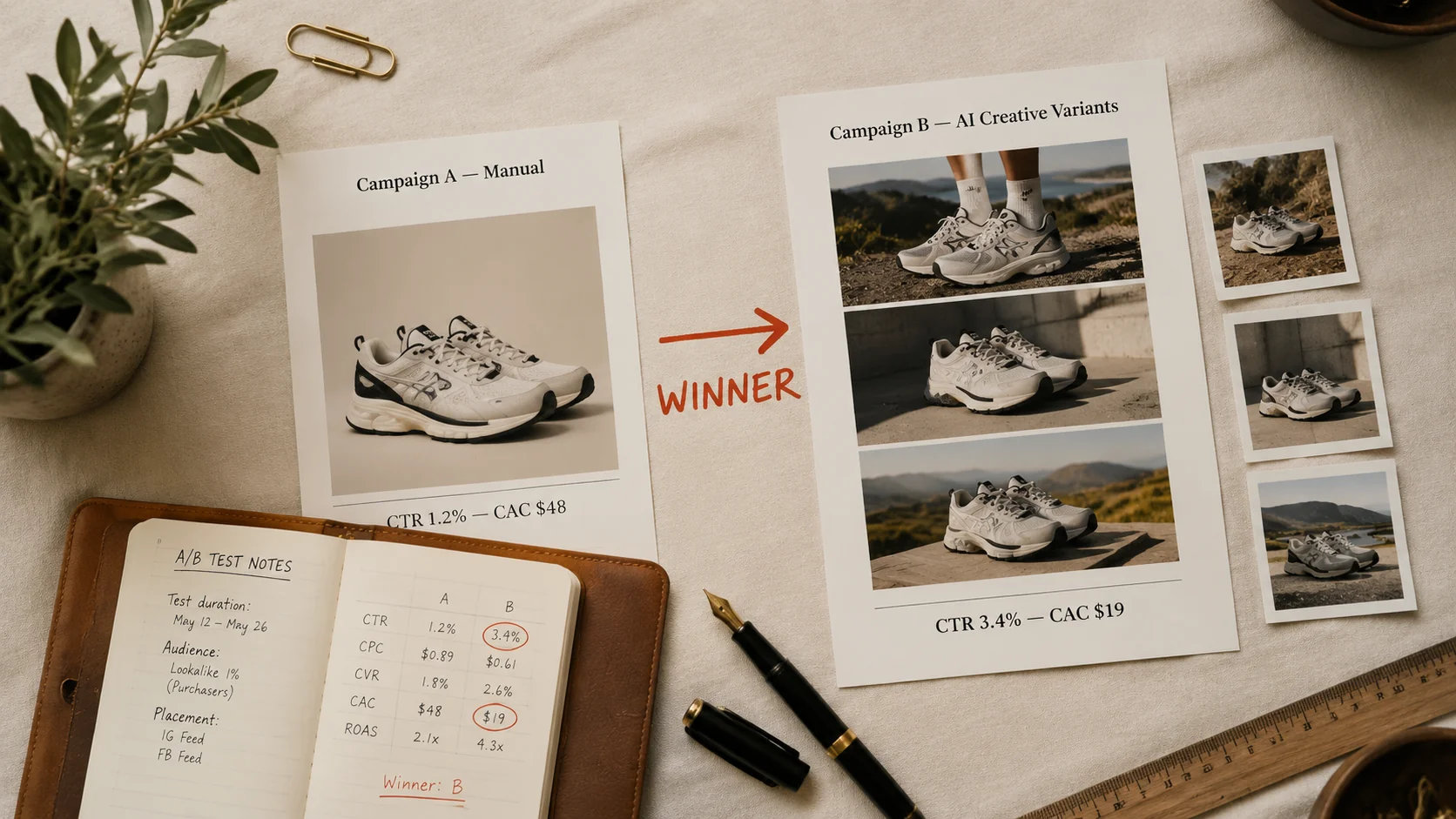
Lower per-asset cost lets you run more creative variants in parallel. McKinsey-cited campaign data shows AI-driven campaigns delivering ~32% more conversions and ~22% higher ROI than control campaigns — and the dominant driver is variant count, not "smarter" creative. More shots on goal beats one carefully crafted shot.
Practical version: if your media team was running 4 ad variants per campaign in 2024, the 2026 standard is 12-20. The Kubeez Ads workspace and AI ad copy generator exist specifically for this batch-variant workflow.
#Lever 3 — Personalization ↑ (variants per segment)
Salesforce's State of Marketing 2026 found that 78% of marketers say they need more personalized content than they can currently produce. AI-generated variants close part of that gap. The honest caveat: most teams are using AI to make 50 versions of the same generic email, not 50 versions tuned to 50 segments. Personalization ROI shows up only when the variants are tied to real audience data, not just synonym swaps.
#Lever 4 — Time-to-launch ↓
Salesforce reports high-performing AI marketing teams save ~8 hours per week through automation. McKinsey's marketing-function ROI table puts AI content drafting at 3.2x ROI and personalization engines at 2.7x ROI — both driven primarily by speed, not by output quality. Campaigns that took two weeks to ship now ship in three days, which compounds across the year.
#Lever 5 — Cross-channel scale ↑
The biggest underrated lever. AI lets one creative concept ship to TikTok 9:16, IG 1:1, YouTube 16:9, email header, and a paid display set in a single afternoon. Kubeez batch generation across video and images is built around this fan-out workflow.
#Lever 6 — CAC ↓ via better creative-to-conversion fit
This is the lever the CFO cares about. Aggregator data (cited in 2026 industry surveys) suggests AI-optimized ad creative yields ~41% lower cost per acquisition in well-instrumented programs. Caveat: this number is from vendor and consultancy aggregations, not from a single audited primary study. Treat the direction as real, the magnitude as best-case. The lever is real because more variants means better winners; the magnitude depends entirely on your measurement discipline.
#Lever 7 — Headcount efficiency
Salesforce reports a 20% ROI lift and 19% cost reduction for marketers who deploy AI well. In practice, this shows up as flat headcount supporting 2-3x more campaign throughput — not as layoffs. Teams that hit the cost-reduction number kept their humans and stopped hiring junior content roles they used to backfill.
#Where AI marketing ROI is fake (or unproven)
This is the part the vendor decks skip. The 2026 data is unambiguous on three places where AI marketing underperforms — or actively destroys value.

#Brand strategy and distinctiveness
72% of marketing leaders surveyed in 2026 industry research believe AI-generated content is actively harming brand distinctiveness. When everyone has access to the same models, everyone produces similar outputs — and brand becomes the only moat. The teams winning here are using AI for production while keeping strategy, voice, and distinctive creative direction firmly human.
#Complex B2B nurture
51% of B2B organizations implementing AI report not achieving expected outcomes (per 2026 B2B performance marketing reports). The structural reason: complex B2B buying involves 6-12 stakeholders, multi-quarter cycles, and high-context conversations where generic AI-generated nurture sequences read as spam. Volume hurts, not helps. The fix is using AI for research and personalization input, not for the actual outbound message.
#Regulated industries
For medtech, pharma, financial services, and legal, AI marketing output requires the same compliance review process as human-written copy — which kills most of the speed advantage. The 2026 industry consensus: AI for input gathering and draft starts, humans for the final word, regulatory review unchanged.
#The measurement gap is the real story
The single most important 2026 stat: the share of marketers who can attribute ROI to AI dropped from 49% to 41% year over year (HubSpot). Adoption is up; provable ROI is down. That's not because AI stopped working — it's because teams skipped the measurement infrastructure when they were running pilots and now can't go back and reconstruct attribution.
If you take one thing from this post, take this: set up clean measurement before you scale AI marketing spend, not after. That means:
- Ad-platform conversion APIs wired up before you launch the AI variant test, not after
- Holdout groups on at least one campaign per quarter to measure incrementality, not correlation
- Per-channel CAC tracked monthly with a 6-month rolling baseline
- A line item in your monthly review that names AI-attributable revenue and AI-attributable cost separately
Without this, you'll be in the 41% who can't prove ROI — and your AI budget will be the first line item cut in the next downturn.
#How to actually capture the ROI levers
The 2026 data tells you which levers exist. The harder problem is operationalizing them on a real team. Here's the minimum stack.
#1. One platform for production, not five
Vendor sprawl kills ROI. Per 2026 research, B2B organizations using 11-25 marketing tools report ~90% unclear ROI; teams using 6-10 tools cut that to 62% (still bad, but better). Consolidation is itself an ROI lever.
Kubeez consolidates the production layer: video generation, image generation, ad creatives, auto captions, AI ad copy, music — all on one credit balance, one billing line, one usage report.
#2. Automate the fan-out, not the strategy
Use AI for the parts where volume and speed compound: variant generation, format adaptation (9:16 / 1:1 / 16:9), translation, captions. Keep humans on the parts where distinctiveness compounds: positioning, hook concepts, brand voice, the actual creative idea.
The Kubeez MCP integration and REST API are built for this — your strategists write the prompt, the platform handles the production fan-out across channels.
#3. Measure incrementality, not correlation
A holdout test once per quarter. AI variant vs. last-year-best variant, same audience, same spend, measured on incremental revenue not platform-attributed conversions. This is the single highest-ROI activity in your AI marketing program — because it lets you defend the budget when the next CFO question comes.
#4. Build a vendor-neutral playbook
The biggest 2026 risk for marketing leaders is locking your team's workflow into one vendor's UI. Models change every six weeks; vendors get acquired. The teams winning long-term are the ones who built a model-agnostic content pipeline — Kubeez offers 40+ models behind one API for exactly this reason. See our marketing AI guide and the ad creatives that convert deep-dive for the full playbook.
#Frequently asked questions
What's the realistic AI marketing ROI for a mid-market brand in 2026? The honest range from primary research: 15-25% cost reduction in creative production within the first six months, 20-30% lift in conversion volume from running more variants, and ~20% overall marketing ROI lift if measurement infrastructure is in place. Teams quoting 10x lifts are either cherry-picking one campaign or counting time saved as revenue.
Is the 41% ROI-attribution number really dropping? Yes — that's the HubSpot 2026 data point and it's directionally consistent with the McKinsey finding that 51% of B2B organizations don't achieve expected AI outcomes. Adoption outran measurement.
Where should a CMO start in 2026? Pick one paid-ads campaign, run an AI-variant batch (10-20 creatives) against your last-year-best control, instrument incrementality measurement, and let the data set the next move. Kubeez Ads and AI ad copy are the fastest way to run that test in a single afternoon.
Does AI work for B2B? For research, ICP analysis, content production, and ABM personalization — yes. For the actual outbound message in a complex 6-12 stakeholder cycle — no, the 2026 data shows volume backfires. Use AI for input, not output, on B2B nurture.
What's the single biggest mistake teams make? Skipping measurement, then scaling spend. Set up incrementality testing first.
Bottom line: the 2026 AI marketing ROI data is real but narrower than the vendor decks claim. The seven levers above are honest. The places where AI underperforms are non-negotiable. The teams that win in 2026 are the ones who consolidate production on one platform, automate the fan-out (not the strategy), and measure incrementality from day one — not the ones with the biggest AI budget.
Kubeez is built for the production-consolidation layer of that stack. Start with Ads, Images, and Video Generation, wire in via MCP or the REST API, and put your measurement infrastructure in place before you scale.
Sources cited: McKinsey State of AI 2026, HubSpot State of Marketing 2026, Gartner CMO Spend Survey 2026, Salesforce State of Marketing 2026, BCG AI value-creation research 2025-2026.
See also