Replace 12 Marketing Tools with One AI Stack: 2026 Playbook
AI marketing tool consolidation in 2026 — map 12 SaaS categories you can replace with one Kubeez stack. Cut $500+/mo without breaking your pipeline.

Your marketing stack is a graveyard of half-used logins. Two stock libraries you forgot you're paying for. An AI image tool you replaced last quarter — but the subscription is still active. A captioning app, a translator, an ad-copy generator, a variant maker, a scheduler, a CRM, three "AI assistants." The invoices stack up faster than the work ships.
This is AI marketing tool consolidation — and in 2026 it's the single highest-leverage move a small marketing team can make. Below is a concrete map of which tools you can actually replace, which you should keep, and how to migrate without breaking your pipeline.
#The marketing SaaS stack 2026 problem, by the numbers
The data isn't subtle. From the most recent industry reports:
- The average B2B organization runs 12–20 marketing technology tools, with two-thirds of marketers using 16 or more for overlapping functions.
- 64% of marketing leaders say they struggle to keep track of all the tools in their stack.
- Only 31% report their martech stack is well integrated.
- Martech utilization has fallen to 49% — meaning roughly half of every stack is collecting digital dust.
- Stack size grew 9% year-over-year between 2024 and 2025.
- Average SaaS spend per employee is now around $5,607/year — close to $467/month.
For a 5-person marketing team, the math is brutal: $20–30k/year in subscriptions for tools you barely log into, plus the integration tax — your data living in six places, no single source of truth, and a Monday morning ritual of copy-pasting between dashboards.
This is the SaaS sprawl problem. The 2026 fix isn't another tool. It's collapsing categories.
#Why now: the AI all-in-one marketing tool moment
Three forces converged in late 2025 to make consolidation genuinely possible:
- AI-native platforms became multi-modal. A single platform can now generate images, video, music, voice, captions, ad creative, and copy at quality that beats most point tools.
- MCP and API surfaces matured. Modern AI platforms expose the same capabilities through both a UI and a programmatic interface — so the same tool that produces creative manually can be wired into automated workflows.
- Pricing collapsed. Credit-based pricing on a unified platform is dramatically cheaper than 6–8 separate subscriptions, because you're not paying overhead twice.
That last one is the kicker. You're not just consolidating tools — you're consolidating margins.
#The consolidation map: 12 categories, replaced
Here's the concrete mapping. We're being honest: a few of these you should keep (a scheduler, your CRM, your analytics — Kubeez is not those). But everything in the creative production stack, plus the supporting AI layers, can collapse into a single workspace.
| Tool category | Old tool example (generic) | Old monthly cost | Kubeez replacement | Notes |
|---|---|---|---|---|
| Stock images | A stock library subscription | ~$29/mo | /images — generate exactly what you need | No more browsing 4M near-misses |
| Stock video | A stock video library | ~$39/mo | /video-generation | Brief-driven instead of search-driven |
| AI image generator (point tool) | A single-model image app | ~$49/mo | /images — Nano Banana 2, GPT Image 2, Flux 2, Z-Image | One credit pool, pick model per job |
| AI video generator (point tool) | A single-model video app | ~$99/mo | /video-generation — Kling 3, Veo, Seedance 2, Wan | Multi-model means you can A/B fast |
| Voice / TTS | A standalone TTS subscription | ~$99/mo | /audio/dialogue | Multilingual, royalty-free |
| Music library | A royalty-free music sub | ~$24/mo | /audio/music | Generate to brief, not to keyword |
| Captioning tool | A separate captions app | ~$19/mo | /media/auto-captions | Multilingual, styled |
| Ad copy AI | A copywriting AI subscription | ~$49/mo | /media/ad-creator/copy-ad | Headlines, scripts, CTAs |
| Variant / creative scaling | An ad variant generator | ~$59/mo | Built into ad creator | Same credit pool |
| Translation | A document translation tool | ~$39/mo | Built into dialogue + captions | Per-locale at the source |
| Dev / API integration | A no-code AI workflow tool | ~$89/mo | /docs/api-overview — REST API | Pay per generation, not per seat |
| MCP / agent integration | (often DIY glue code) | (engineer hours) | /settings/mcp — native MCP | Claude, Cursor, n8n in minutes |
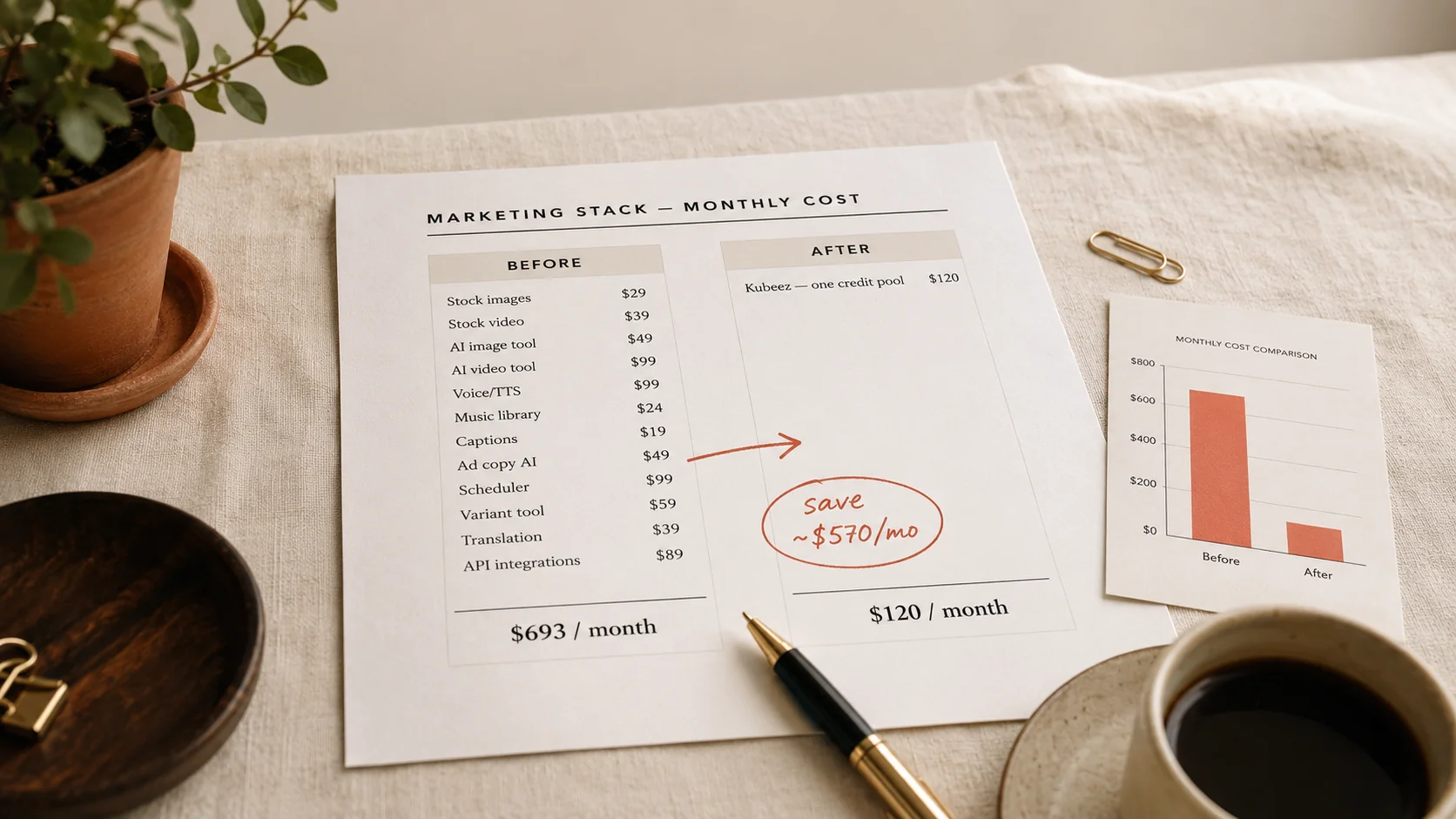
Combined "before" cost: roughly $593–$700/month for the SaaS subscriptions alone, before the engineering hours to wire them together.
After: a single credit balance and a single login. You now scale spend with output volume, not with seat count.
What you should still keep:
- Your social scheduler (Buffer, Later, Sprout) — Kubeez is a generation platform, not a publishing platform.
- Your CRM (HubSpot, Salesforce) — different category entirely.
- Your analytics (GA4, Mixpanel, Amplitude) — Kubeez doesn't measure your funnel.
This is honest. Don't replace what works.
#What "one AI stack" actually buys you
The headline savings are obvious — $400–$600/month for a small team. But the deeper wins compound:
One credit pool, model flexibility. When you have access to Kling 3, Veo, Nano Banana 2, GPT Image 2, Z-Image, Seedance 2, and others through a single balance, you stop overpaying for premium models on jobs that don't need them. Draft on Z-Image, finish on Kling 3 Pro. We covered the full lineup in All the AI Models You Need, in One Place.
Unified asset library. Every image, video, music track, voiceover, and caption file lives in one searchable workspace. Your "best generations" become a reusable archive instead of a folder maze across six platforms.
One automation surface. Through the Kubeez MCP and REST API, every tool becomes scriptable. The same workflow that generates your weekly carousel manually can be triggered from Claude, Cursor, n8n, Zapier, or your own backend. Read more on the integration approach in Kubeez API + MCP: AI Content Automation.
No version drift. When a single platform updates Nano Banana to NB2 or ships Seedance 2 Fast, every workflow inherits the upgrade. No "but the export format changed" tickets.
One billing line on your P&L. Finance loves you. Procurement loves you. The CFO who was about to ask why you have eleven SaaS subscriptions loves you.
#The migration path: don't rip-and-replace
The single biggest failure mode in any consolidation is trying to swap everything in one weekend. Don't. Here's the four-phase migration that actually ships:

#Phase 1 — Creative production (week 1–2)
Migrate the highest-volume creative work first: images, video, music. This is where the credit savings appear fastest and where Kubeez beats single-model point tools by the widest margin.
- Pick a real project (next campaign, next product launch).
- Generate the hero image, supporting visuals, background music, and short video assets entirely on Kubeez.
- Track time-to-final vs your old workflow.
If it takes you 30% less time and produces output you'd actually ship, you have your answer.
#Phase 2 — Captions and ad copy (week 3)
Layer in auto-captions and ad copy for the content you're already producing. This is where most teams realize they've been paying for three tools that do the same thing.
Cancel the standalone captioning subscription at the end of the month. Cancel the ad copy AI tool. Total: $40–80/month back.
#Phase 3 — MCP / API automation (week 4–6)
For teams with even one engineer (or a savvy operator), this phase is where the leverage shows up. Wire Kubeez into your existing automation:
- Connect the MCP to Claude, Cursor, or your agent stack.
- Use the REST API to trigger generations from your CMS, your campaign manager, or n8n flows.
- Replace one-off "AI workflow tools" that were just orchestrating other AI APIs.
This is where you eliminate the most expensive subscriptions ($89–199/month "AI workflow" platforms) because Kubeez exposes the same capabilities natively.
#Phase 4 — Keep what works
Your scheduler, CRM, and analytics stack stays. Connect them via webhook or API where useful. Don't force a migration that doesn't make sense — the goal is fewer tools that do more, not "Kubeez everything."
#What a consolidated 2026 stack looks like
For a typical 3-person marketing team after consolidation:
- Creative production: Kubeez (images, video, music, voice, captions, ad creative)
- Distribution: Your scheduler (Buffer / Later / Sprout)
- Customer data: Your CRM (HubSpot / Salesforce)
- Measurement: Your analytics (GA4 / Mixpanel)
- Automation glue: Kubeez MCP + API → Claude / n8n / Zapier
That's four core tools. You might add a one-off (a project tracker, a brand asset manager) — but the bloat of 16+ overlapping AI subscriptions is gone.
For agencies, the consolidation story is even sharper. We unpacked it in How AI is Helping Marketing Agencies Scale Content in 2026.
#FAQ
How much can a small marketing team realistically save by consolidating? For a 3–5 person team running a typical 12–16 tool stack, consolidating creative production and AI tooling onto a single platform like Kubeez typically frees up $400–$700/month in subscription spend, plus 5–10 hours/week in context-switching and copy-paste work.
Will I lose features by replacing point tools with a multi-model platform? For 80% of jobs, no — the point tools and Kubeez use the same underlying frontier models (Kling 3, Veo, Nano Banana, Flux, GPT Image 2). For specialty workflows (e.g. a niche audio mastering tool, a vertical-specific automation), keep what genuinely differentiates.
What if I already have annual contracts on tools I want to drop? Don't cancel anything you've prepaid. Migrate the workload now, run both systems in parallel until renewal, and don't renew. The cost is the same; the migration is risk-free.
Does Kubeez handle social scheduling and analytics? No — and intentionally so. Kubeez is a generation and creative production platform. Pair it with your existing scheduler, CRM, and analytics stack. The goal of consolidation is fewer tools that do their job well, not one tool that does everything badly.
Can I integrate Kubeez with my existing automation tools? Yes — through the Kubeez MCP (native integration with Claude, Cursor, and other MCP-compatible agents) and the REST API (works with n8n, Zapier, Make, or your own backend code). Most teams complete an integration in a single afternoon.
#The 2026 takeaway
Marketing SaaS sprawl is a tax you've been paying for years and didn't notice. In 2026, AI-native consolidation is finally a credible alternative — not a downgrade, not a compromise, just less software doing more work.
Start with one category. Run it for a sprint. Then expand. The teams that consolidate this year will spend the rest of the decade with thinner stacks, faster pipelines, and the kind of focused workflow that makes the bloated competition look slow.
See also