The True Cost of Marketing in 2026: AI vs Traditional, Side-by-Side
Real 2026 numbers comparing in-house, agency, and Kubeez AI marketing cost — for the same monthly content output. Where AI saves 70%, where it loses.
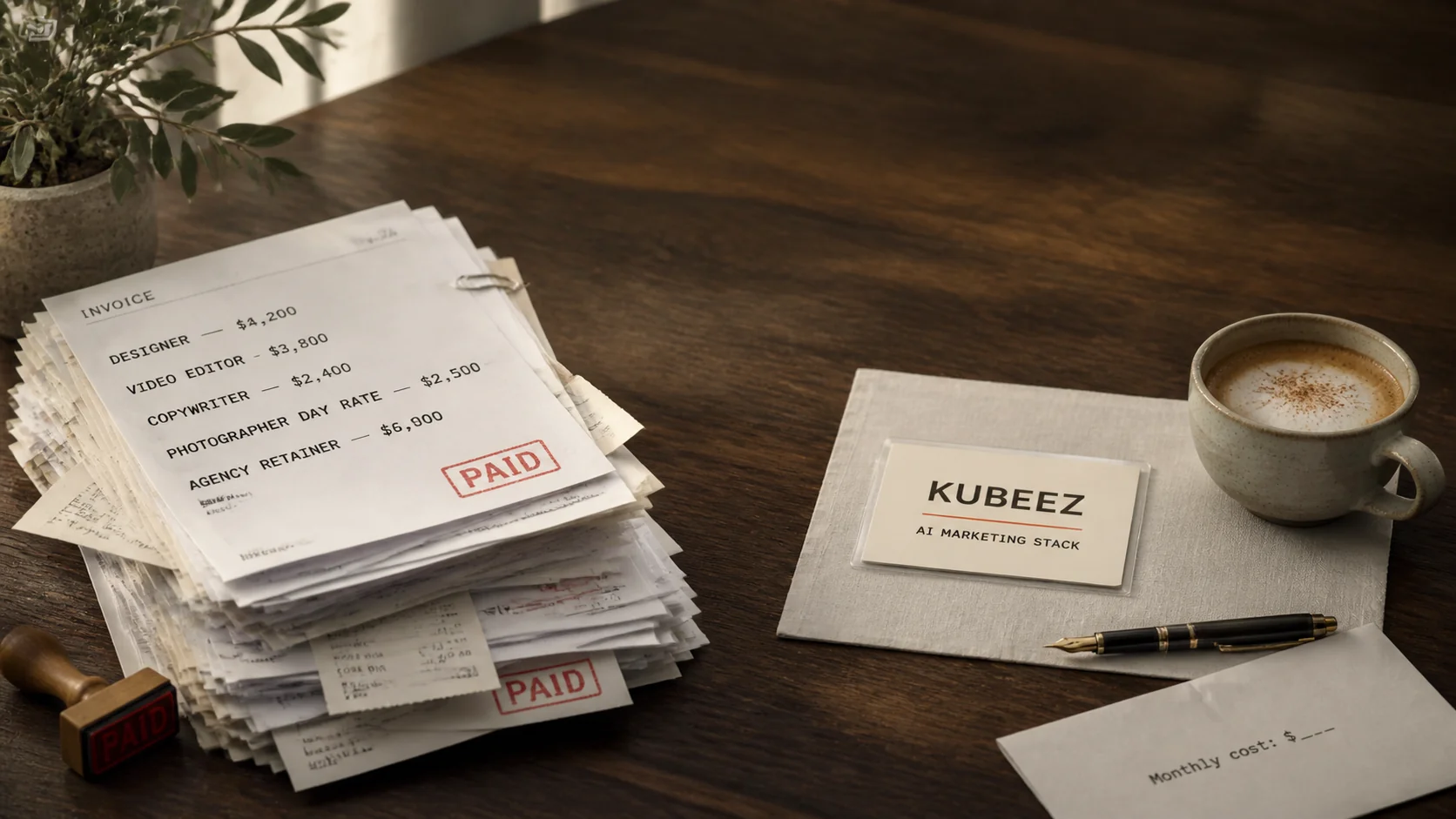
If you run a small business or sit on the finance side of a marketing budget in 2026, you have already noticed the squeeze: clients want more output, audiences want more channels, and the people on payroll cost more than they did last year. The question is no longer whether AI changes the marketing P&L. It's by how much, and where the savings are real vs the savings that quietly cost you more downstream.
This is an honest, line-by-line comparison of what it costs to ship the same monthly content output under three setups: an in-house team, a traditional agency retainer, and an AI-first stack on Kubeez plus one operator. We use real 2026 data — Gartner, HubSpot, Glassdoor, Vidico, public agency rate cards — not vendor-supplied numbers. Where AI loses, we'll say so plainly. Where it crushes the production-cost layer, the table will show you why most CFOs are quietly rebuilding their marketing org in 2026.
#The 2026 baseline: marketing budgets are flat, expectations are not
Before we put any numbers on a table, the macro picture matters.
- Marketing budgets have flatlined. Gartner's 2025 CMO Spend Survey reports marketing at 7.7% of company revenue, unchanged year-over-year and still well below the 2020 high of 11%. 59% of CMOs say they don't have enough budget to execute their strategy.
- Small businesses are spending more — but not winning. HubSpot's 2026 State of Marketing Report found that 68% of small business owners plan to increase marketing budgets in 2026, but fewer than 20% feel confident any of it is actually working.
- AI is no longer a side experiment. Sprout Social's 2025 Index reports 97% of marketing leaders now say AI proficiency is vital for proper job performance, and every major social tool ships AI for content generation, scheduling, sentiment, and reporting by default.
Read those three lines together and the assignment is obvious: the budget is not growing, the output expectation is, and the incumbent solution (more headcount or more agency retainer) is no longer affordable. Something has to give. The CFO question is which line item.
#The benchmark output: what a "real" SMB content month looks like
To make a fair comparison, we hold the deliverable constant. The bundle below is a realistic monthly content load for an SMB doing serious organic + paid social in 2026:
- 30 social posts (mix of static + short caption posts across IG, LinkedIn, X)
- 20 short video ads (15–30s, mostly 9:16 vertical for TikTok / Reels / Shorts)
- 10 image ads (stills with text overlay, multiple aspect ratios for Meta and Google)
- 100 captioned video clips (auto-captions for the 20 ads + repurposed long-form to short)
- 10 ad copy variants (headlines + primary text for Meta / Google ads)
- 1 simple background music track for branded video
That bundle is what a competent in-house team or mid-tier agency would call "one month of content." We're going to price it three ways.
#Cost #1 — The in-house team
The honest in-house build for the bundle above is four roles. You can technically do less, but you'll either burn out one person or quietly cut the deliverable count.
| Role | US median 2026 base | Loaded cost (1.3x) | Source |
|---|---|---|---|
| Social media manager (mid) | ~$79,500 | ~$103,000 | Glassdoor |
| Graphic designer | ~$62,750 | ~$81,500 | Glassdoor |
| Video editor (mid) | ~$70,000 | ~$91,000 | PayScale |
| Copywriter | ~$75,000 | ~$97,500 | AMA Chicago |
Loaded cost ≈ base salary + payroll taxes, benefits, equipment, software, and the share of office/overhead. The 1.3x multiplier is conservative for the US — agencies and finance teams typically use 1.3–1.5x.
Total annual fixed cost: ~$373,000/year ≈ $31,000/month before tools.
Then add the production tools and the assets you still need to license:
- Adobe Creative Cloud + Figma + project management: ~$280/month
- Stock footage / music / fonts licensing: ~$200/month
- Occasional photographer day rate (one shoot/quarter): $30–$250/hr per Solo Hourly's 2026 calculator; budget ~$800/month amortized
- Project management seats (Notion, Slack, Asana): ~$120/month
In-house total for the benchmark bundle: ~$32,400/month, or ~$389,000/year.
What you get for that: deep brand fluency, editorial taste, in-the-room judgment. What you also get: holiday risk, ramp-up time when someone leaves, and a cost base that doesn't shrink the month you have a slow product launch.
#Cost #2 — The agency retainer
The full-service option. You hand the bundle to a marketing agency and write one cheque a month.
According to ClicksGeek's 2026 marketing agency pricing analysis, the typical SMB engagement (under 50 employees, under $10M revenue) lands at $2,500–$8,000/month for a focused scope, with full-service retainers spanning $2,500–$30,000/month depending on channels and ad spend management. WebFX confirms a similar range.
For our 30/20/10/100 bundle — which spans social, video, image ads, and captions — the realistic mid-market US/EU agency price is ~$5,000–$8,000/month base retainer, plus the inevitable per-campaign uplifts:
| Line item | Monthly cost | Source |
|---|---|---|
| Base full-service retainer | $5,000–$8,000 | ClicksGeek 2026 |
| Short-form video ad production (20 spots @ ~$1,500 base) | Often charged per project; SMB short-form social runs $1,500–$5,000 per spot per Vidico's 2026 guide — agencies typically bundle 4–6 of these into the retainer and bill the rest | $3,000–$6,000 add-on |
| Photography day or stock allocation | $500–$1,500 | |
| Ad spend management fee (if you run paid) | $1,500–$5,000 | 12AM Agency 2026 pricing |
Realistic blended monthly cost for the same bundle through an agency: ~$8,500–$15,000/month, or ~$100,000–$180,000/year.
The good news: you trade fixed cost for variable cost. The bad news: you get fewer creative variants per campaign than an in-house team would produce, and the wait time per asset goes up. WebFX and Searchlab's 2026 reality-check guide both flag the same complaint from SMB clients: "We're paying for the brand work, but the variant testing we actually need to find a winning ad never happens because every variant is its own line item."
#Cost #3 — The Kubeez AI stack + one operator
Now the comparison. Same deliverable bundle, same monthly cadence, this time produced by one in-house generalist running Kubeez as the production layer.
What that operator's day actually looks like:
- They open Kubeez in the morning, write three brand-locked prompt templates per week (one for product stills, one for short video ads, one for image ads), and store them in Notion.
- The 30 social posts each batch through GPT Image 2 or Nano Banana 2 at standard 1K resolution — 11 credits each on gpt-image-2 per the Kubeez models catalog.
- The 20 short video ads run on Seedance 2 Fast or Veo 3.1 via /video-generation, depending on the brand polish needed.
- The 100 caption passes use Kubeez auto-captions — single upload, returns timed styled subtitles ready for TikTok and Reels.
- The 10 ad copy variants are generated through Kubeez Ad Copy.
- The single background track is produced on Kubeez Music — full 8-minute track on the standard tier costs a tiny fraction of a stock licence.
Realistic monthly cost for the bundle:
| Line item | Cost |
|---|---|
30 image posts on gpt-image-2 1K (~330 credits) | ~$4 |
20 short video ads on seedance-2-fast (~5s avg) | ~$60 |
10 image ads on gpt-image-2 1K (~110 credits) | ~$1.50 |
| 100 auto-caption passes | ~$10 |
| 10 ad copy variants | ~$2 |
| 1 background music track (8 min, std) | ~$2 |
| Generous buffer for re-runs and variants (3x) | ~$240 |
| Kubeez credits subtotal | ~$320/month |
| One generalist operator (US, mid-level marketing generalist, loaded) | ~$6,500/month |
| Tools (Notion, Figma free tier, Slack) | ~$60/month |
Kubeez AI stack total: ~$6,900/month, or ~$83,000/year.
That is roughly 78% less than in-house and 40–55% less than the equivalent agency retainer — for the same 30/20/10/100 bundle, with 2–4 variants per asset by default instead of one.
#Side-by-side: the cost comparison table
| Line item | In-house team | Agency retainer | Kubeez AI + 1 operator |
|---|---|---|---|
| Headcount required | 4 FTEs | 0 internal | 1 generalist |
| Base monthly cost | $31,000 | $5,000–$8,000 retainer | $6,500 (operator) |
| Production cost (per bundle) | Included in salary | $3,500–$7,000 add-on | ~$320 in credits |
| Tools / software | $400–$800 | $0 (agency-side) | $0–$60 |
| Photography / stock | $500–$1,000 | $500–$1,500 | $0 |
| Ad spend management fee | $0 (in-team) | $1,500–$5,000 | $0 (you run it) |
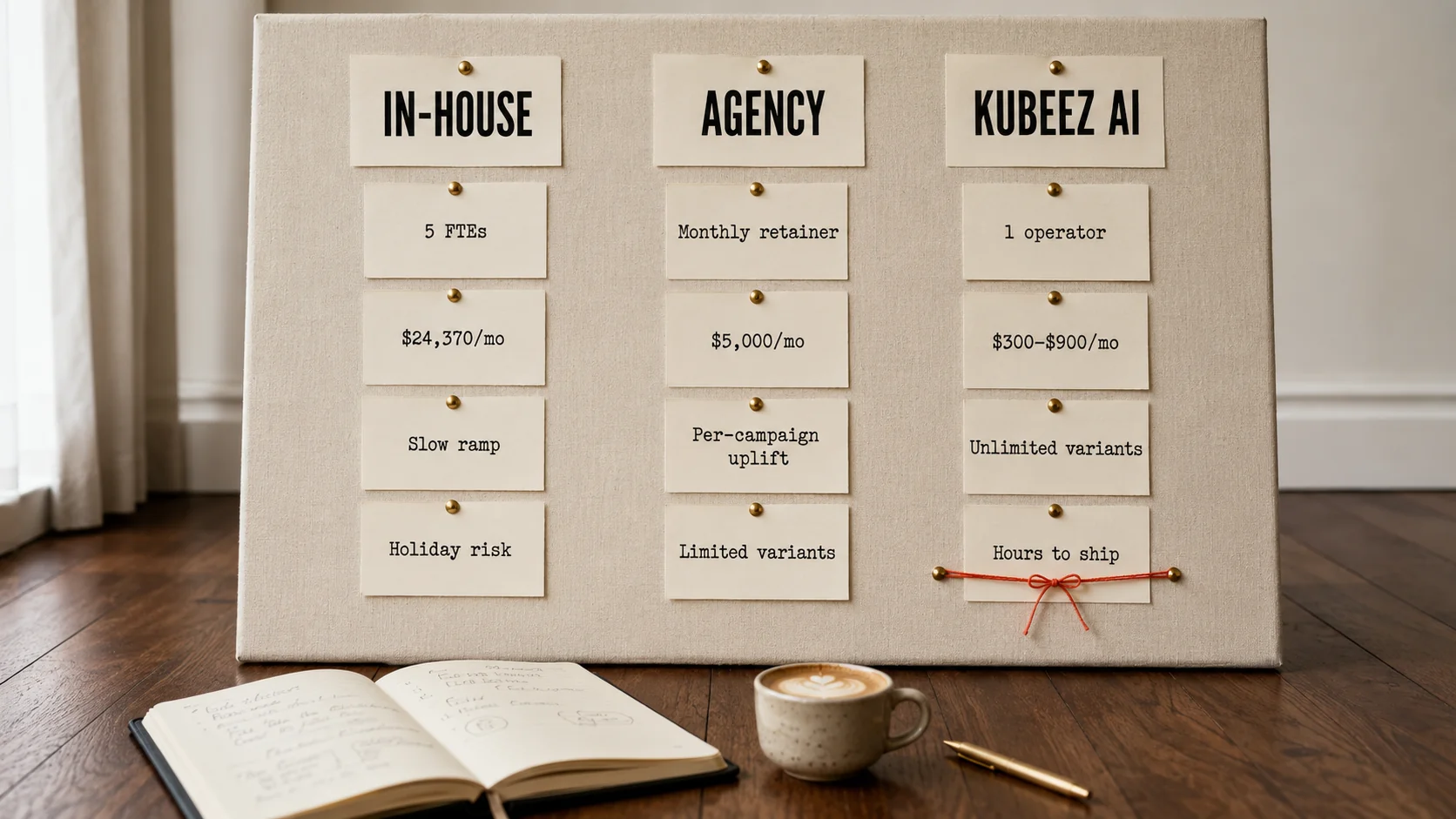
| Total monthly | ~$32,400 | ~$8,500–$15,000 | ~$6,900 |
| Annualized | ~$389,000 | ~$100,000–$180,000 | ~$83,000 |
| Variants per asset (typical) | 1–2 | 1 | 2–4 |
| Time to first asset | Days | 1–2 weeks | Hours |
| Holiday/sickness risk | High | Medium | Low |
| Brand judgement | Highest | High | Operator-dependent |
The headline isn't that AI is cheaper. The headline is that AI collapses the production-cost layer to almost nothing and lets you redirect that money into either ad spend, brand strategy, or pure margin.

#Where AI loses (and you should be honest about it)
If this post said AI replaces every part of marketing, it would be a pitch deck, not a comparison. The CFO sniff-test demands honesty about where AI does not win:
- Brand strategy and positioning. A generative model does not know your category, your founder story, or why you should price 30% above your nearest competitor. HubSpot's 2026 State of Marketing is explicit on this: consumers say brands should make human-generated, point-of-view content the priority. AI is a production engine, not a strategist.
- Complex, multi-day storytelling. A documentary-style brand film or a 6-month integrated campaign with talent, location shoots, and broadcast media is still a human-led production. AI can absolutely supplement it (storyboard mockups, b-roll fills, captions, alt-language dubs), but it doesn't replace the director.
- B2B relationship sales. ABM, executive briefing decks, partner-driven enterprise sales — these are still human-to-human. AI helps you generate the materials, but the relationship is the deliverable.
- Editorial taste at scale. A senior creative spotting that the second variant in a batch of 20 is the one that actually carries the brand voice — that judgement is still the human's job. The AI's job is to make sure variant 20 exists at all.
If your marketing leans heavily on these strategic, human-to-human deliverables, the AI savings are smaller (closer to 30–40%) because the production-cost layer is a smaller share of your total spend. If your marketing is mostly volume creative, social, performance, and short-form video — the savings can exceed 70%.
#Workflow recommendation by company size
The right answer is rarely "all in-house" or "all agency" or "all AI." It's a stack. Here's the realistic mix by company size based on the math above.
#Solopreneur / freelancer
- Stack: 100% Kubeez + you as operator. You don't have the volume to justify either an FTE or an agency retainer.
- Monthly cost: $50–$300 in Kubeez credits depending on output.
- What you save: the difference between hiring a freelance designer for one ad set ($800–$2,000) and shipping it yourself in two hours.
- Start here: Kubeez Ads and Image generation. Read How to make money with AI for the freelance playbook on top of this stack.
#SMB (10–50 employees)
- Stack: Kubeez + 1 in-house generalist + occasional specialist freelance. No FTE designer or video editor. Use freelance only for brand-defining hero work two to four times a year.
- Monthly cost: ~$6,500–$10,000 all-in.
- What you save vs full in-house: ~$22,000/month.
- Start here: Scale social media with AI maps the exact monthly cadence; wire it through the Kubeez MCP server so your generalist can run batches from chat.
#Mid-market (50–500 employees)
- Stack: Brand strategist + 1–2 senior creatives + Kubeez as the production layer + agency for campaign-level work only. Keep the people who set direction; let AI ship the executions.
- Monthly cost: ~$25,000–$50,000.
- What you save vs the old "agency for everything" model: 30–50% on production line items, with 3–4x more creative variants tested per quarter.
- Start here: Kubeez REST API plus the marketing-agency-scale playbook for codifying client templates.
#Marketing agency itself
- Stack: Same brand + senior team, Kubeez as the production engine. Production-pod headcount drops; output per retainer goes up. Margin recovers.
- See the full agency playbook: How marketing agencies scale content output 10x with AI in 2026.
#The honest bottom line
The CFO answer to "how much should we spend on marketing in 2026" hasn't changed. It's still ~7–10% of revenue per Gartner's 2025 CMO Spend Survey and the broader 2026 industry data. What has changed is what you get for that spend.
In 2024, that budget bought you a small in-house team or a mid-tier agency that produced one finished asset per brief. In 2026, the same budget — channeled through an AI-first stack — buys you the same brand quality at 3–4x the variant count, with 70%+ of the spend redirected to ad media, talent, or margin instead of production overhead.
That's not an AI marketing pitch. That's the new spread between what marketing costs and what it should cost. The companies that close that gap fastest in 2026 will sit on a structural P&L advantage their competitors can't match without rebuilding their org.
If you want to see the math against your own numbers, start a free generation on Kubeez, wire up the MCP server for your stack, or read the practical operator guide: Scale social media with AI.
#FAQ
Is the AI quality really comparable to an in-house designer or agency?
For the production-cost layer — social posts, image ads, short-form video, captions, ad copy variants — yes, the 2026 models on Kubeez (gpt-image-2, nano-banana-2, seedance-2-fast, veo3-1) are at the bar where most SMB clients can't tell the difference, and the ones who can are usually pleasantly surprised. For brand strategy, complex storytelling, and senior taste calls — no, AI doesn't replace those, and you should keep the humans for them.
What's the realistic minimum monthly Kubeez spend for an SMB? Most SMBs running the 30/20/10/100 bundle land between $200 and $400/month in Kubeez credits, plus the cost of the operator. If you generate aggressive variants for A/B testing, expect $500–$900/month.
Do we still need an agency at all? For brand strategy, big-campaign concepting, and complex media planning — often yes, for shorter sprints and on a project basis. For monthly content production — usually no, once you have an operator and Kubeez wired into your workflow.
What about brand consistency across so many AI-generated assets? That's the operator's job. They build a small library of locked prompt templates per brand voice and visual style, store them in Notion or Airtable, and run every batch against those templates. The result is more consistent, not less, than the typical agency that hands different freelancers each brief.
What's the fastest way to test this for our company? Pick one campaign next month — preferably one that needs a lot of variants. Run it through Kubeez via the web app or MCP instead of your normal channel. Measure the time-to-ship and the variant count. Then look at what it cost. The numbers usually settle the debate.
The marketing cost line in 2026 doesn't have to grow to keep up with channel demand. The companies that figured this out early aren't the ones with the biggest budgets. They're the ones who realized that the right AI marketing stack turns the production-cost layer from your largest fixed cost into your smallest variable cost — and redirected the difference into the work that actually moves the brand. That's the structural shift Kubeez was built for. Start free and see your own version of the table above.
See also