Happy Horse vs Kling 3 & Seedance 2: Why a Leaderboard Win Is Not a Workflow
Happy Horse leads a public AI video Elo arena, but no public API, no motion-control transfer, and identity drift on long clips mean Kling 3 and Seedance 2 still win the production workflow on Kubeez.
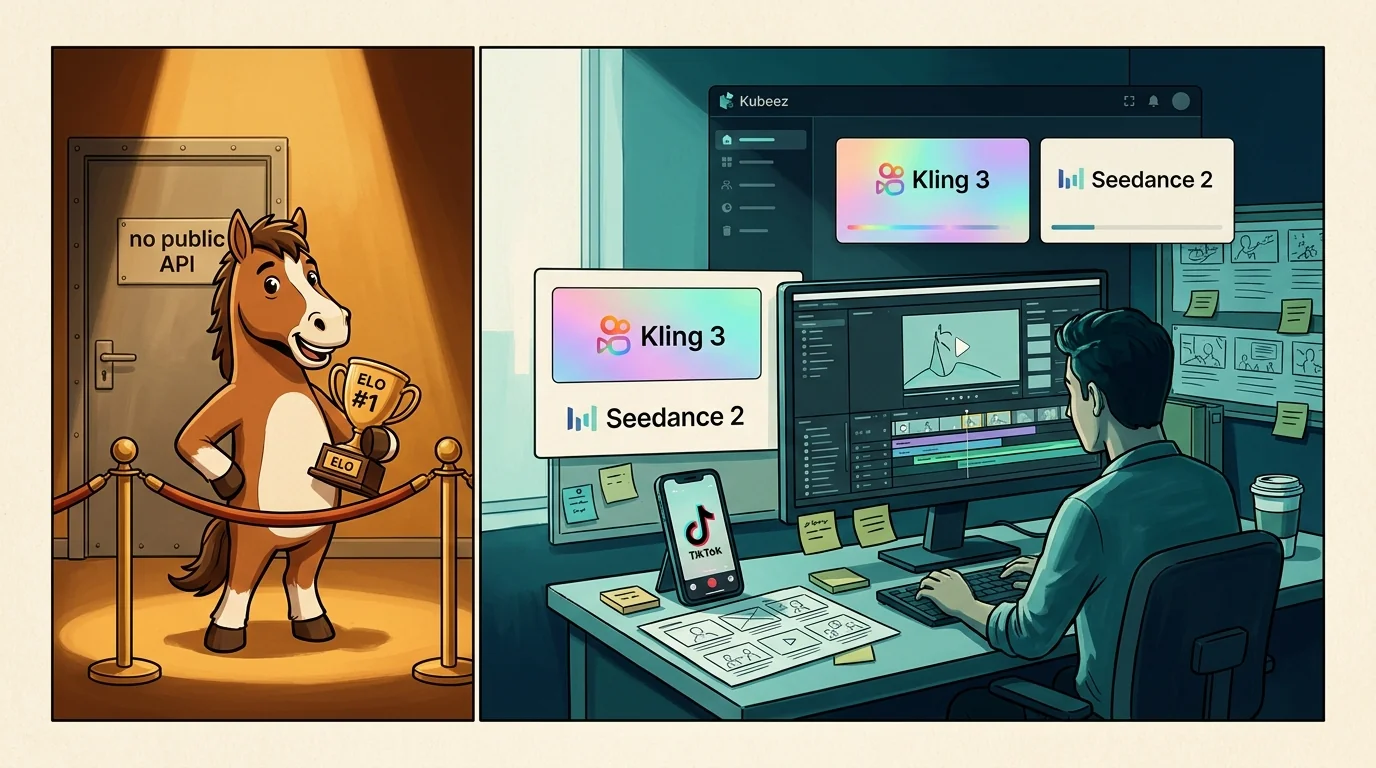
Happy Horse made headlines for topping a public AI video Elo leaderboard. That's a real achievement — and a misleading buy signal. A leaderboard rank tells you what one model can do in a controlled prompt arena. A creator workflow tells you what you can actually ship this afternoon.
If you compare Happy Horse vs Kling 3 and Happy Horse vs Seedance 2 on the things that matter for production — public API, motion control, multimodal reference, with-audio quality, peer-reviewed claims, and "is this thing even deployable" — the picture flips. Kubeez ships both Kling 3 and Seedance 2 today, and Happy Horse is still effectively a closed demo.
#TL;DR
- Happy Horse leads on a single Elo arena number. Real. Confirmed. That's the whole story.
- No public API. No open weights. No motion-control transfer. No peer-reviewed technical report. All confirmed gaps.
- With-audio Elo trails Seedance 2's multimodal pass. The benchmark Happy Horse is most often cited for is video-only, not video+audio.
- Identity drift on extended clips. Multi-shot character continuity is where Happy Horse struggles in long-form testing.
- Kling 3 and Seedance 2 are deployable today on Kubeez via the web app, the REST API, and the MCP server.
The leaderboard is a poster on the wall. The workflow is the building.
#The arena number is real. The product isn't.
Happy Horse posted a strong Elo score in a public head-to-head video arena. We're not contesting that — and a 1v1 prompt arena is a legitimate signal of raw model capability. But arenas measure single-shot output quality from a fixed prompt against a fixed grid of competing prompts. They don't measure:
- Whether you can call the model from your code to ship it.
- Whether the model can take a driving video and re-time motion onto your character.
- Whether multi-track audio (voice + music + SFX) can drive the generation in a single pass.
- Whether the model holds a brand mascot's identity across an 8-shot edit.
- Whether someone has published the methodology for the headline numbers.
On every one of those, Happy Horse currently has either a documented gap or no public surface at all.
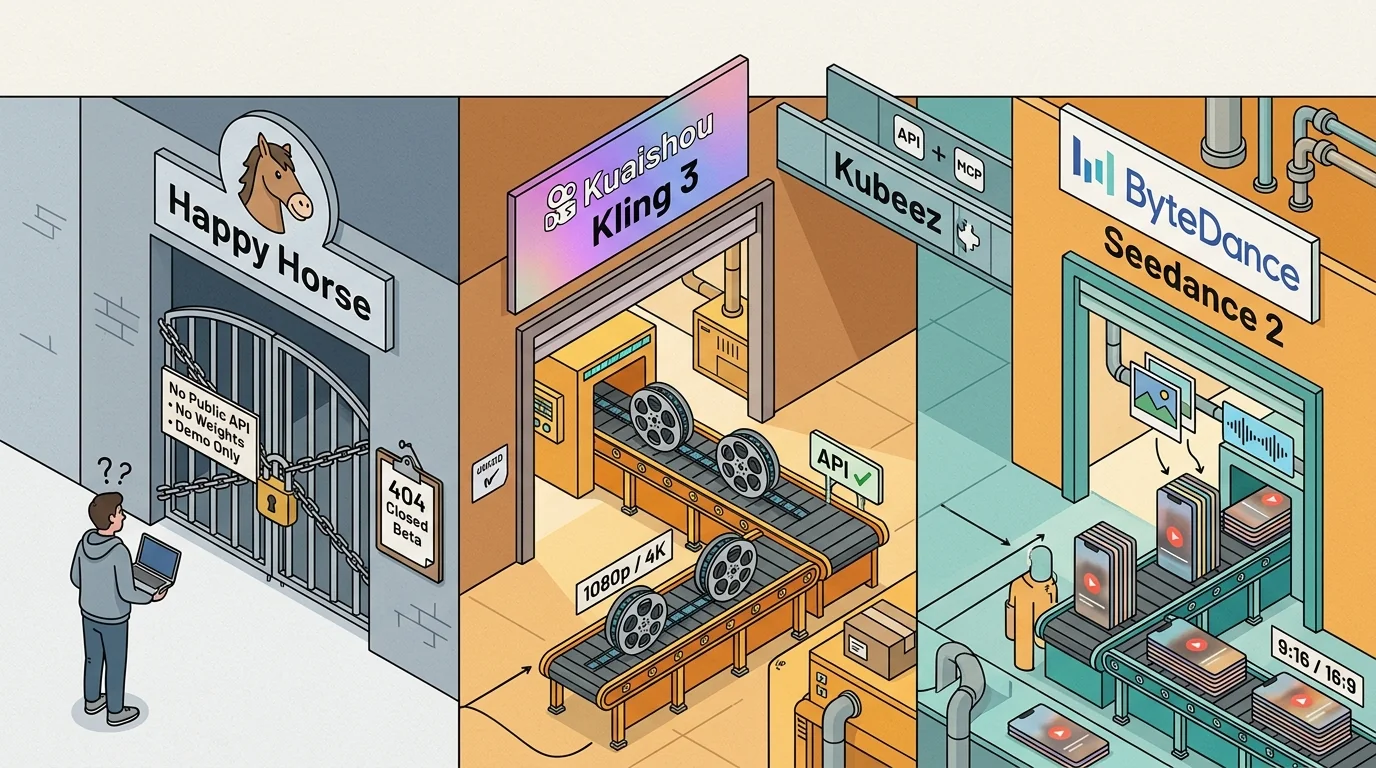
#Where Happy Horse cannot follow you
Production video isn't a single prompt to a single arena. It's a chain of decisions, edits, references, and integrations. Here's where the chain breaks for Happy Horse and stays intact for Kling 3 and Seedance 2.
#1. No public API or weights
You cannot, today, programmatically generate a Happy Horse video from your stack. There's no documented public API endpoint, no SDK, no MCP server, no published model weights. If you're building anything beyond a one-off demo — a content pipeline, an automated ads engine, an internal tool, an agent — Happy Horse is not part of that conversation.
Kling 3 and Seedance 2 ship on Kubeez with REST API, TypeScript and Python clients, and a first-class MCP server so Claude, Cursor, and any MCP-aware agent can call them by name. That's the difference between a leaderboard screenshot and an invoice your client signed off on.
#2. No motion-control transfer
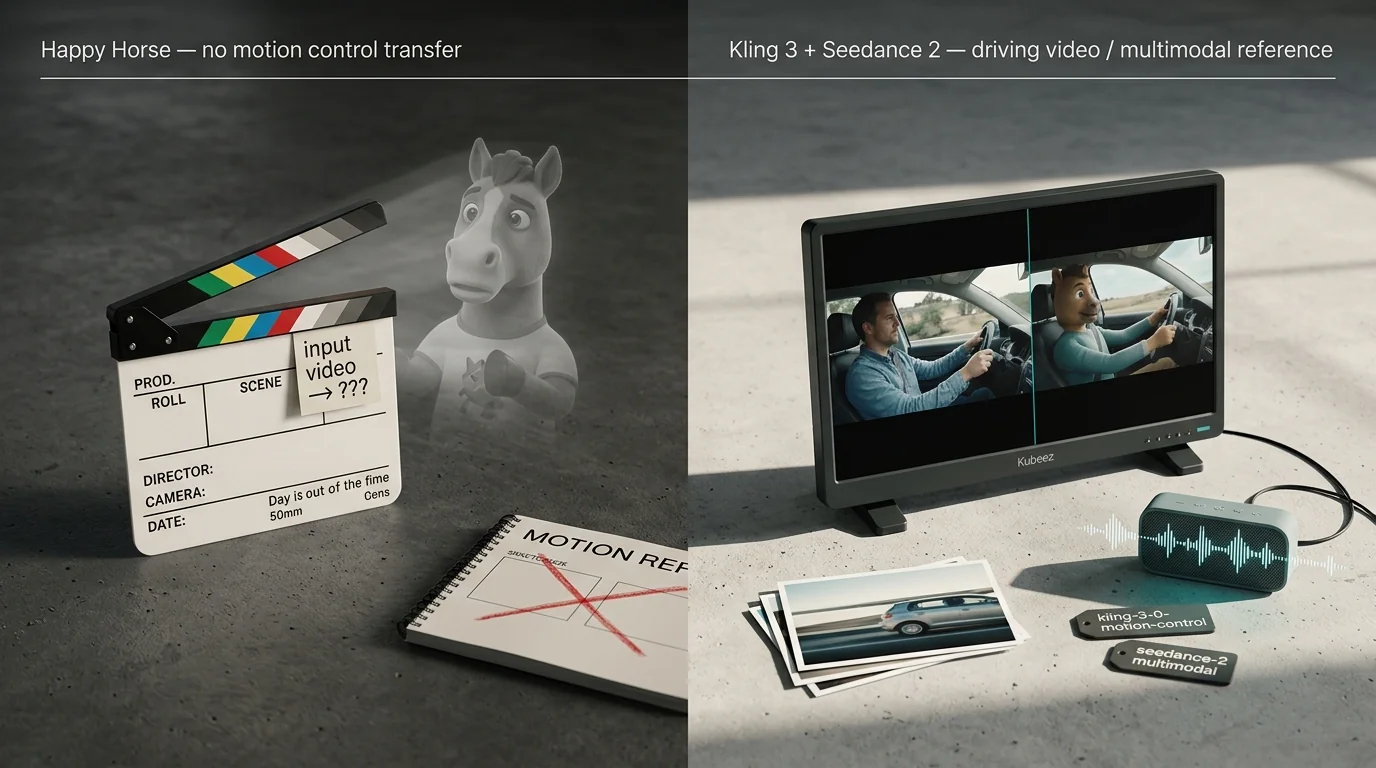
Modern campaign video frequently requires motion-control transfer — feeding the model a driving video (a reference clip with the exact camera move and subject motion you want) and having the model retarget that motion onto a different character or scene. This is how agencies hit a brand-mandated camera move on the third take instead of the thirtieth.
Happy Horse does not expose a motion-control mode in any current public surface. Kling 3 ships kling-3-0-motion-control-720p and -1080p as dedicated motion-control variants. Seedance 2 accepts a video reference directly as part of its multimodal-reference input. If your shot list specifies a camera move from a board, Kling 3 motion-control is the answer; Happy Horse isn't an option.
#3. With-audio Elo: Seedance 2 leads
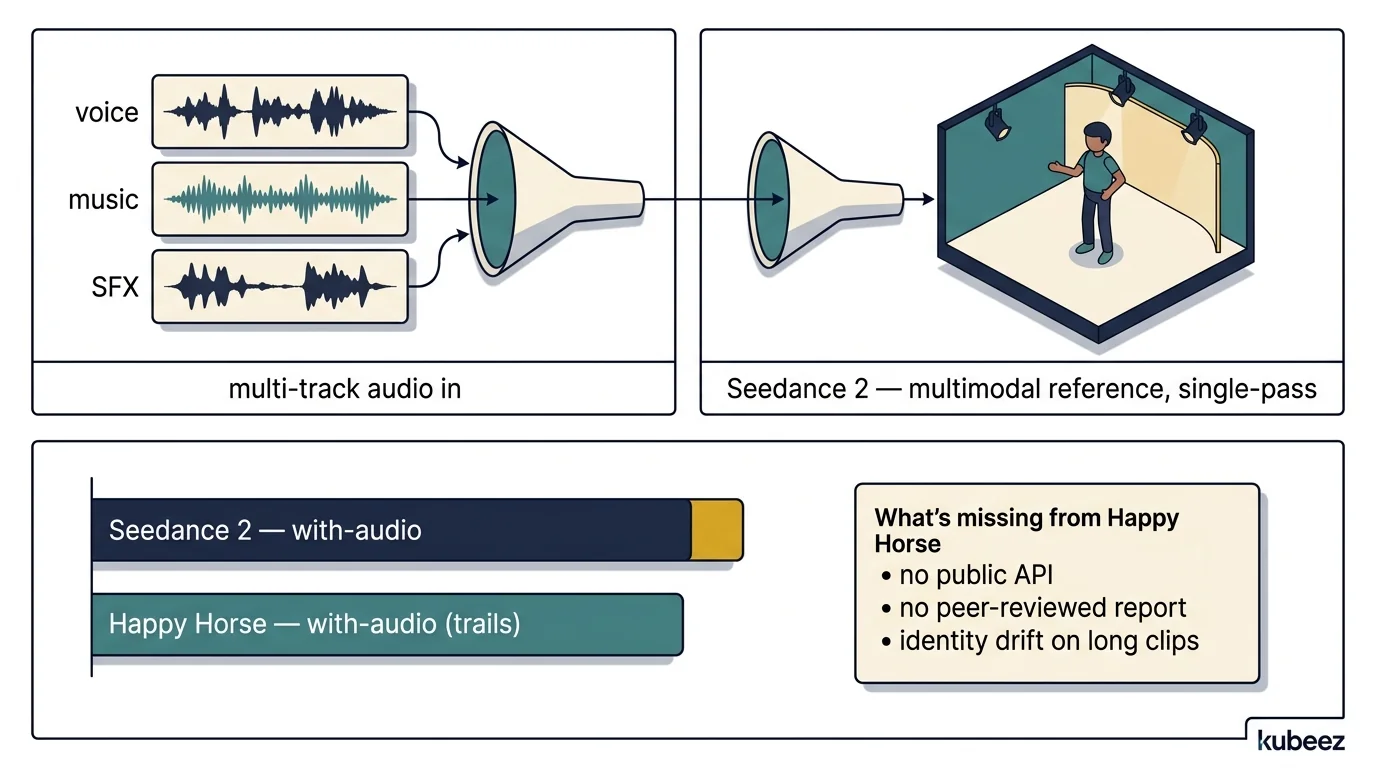
The Elo headline that cited Happy Horse is the video-only arena. The picture changes once audio enters the test. In with-audio comparisons, Seedance 2's single-pass multimodal generation — which accepts up to 9 reference images, 3 reference videos, and 3 reference audio tracks in one call — produces tighter sync and cleaner mix than Happy Horse's video-only outputs that need a separate audio pipeline bolted on after the fact.
If your end deliverable is a TikTok hook, a podcast clip, a dialogue-driven ad, or any social format where the audio carries the message, "won the silent arena" is the wrong benchmark.
#4. Identity drift on extended clips
For brand and character work — recurring mascots, product hero shots, episodic content — the model has to hold the same identity across multiple shots and edits. Happy Horse demonstrates identity drift on extended clips: features wander, proportions shift, the third shot doesn't match the first.
Kling 3's image-to-video with first + last frame anchoring keeps the character locked between two reference frames. Seedance 2 accepts up to 9 reference images for character consistency across a sequence. Both ship as battle-tested options on Kubeez and have years of brand-creative shipping under them, not arena-only validation.
#5. No peer-reviewed technical report
Both Kuaishou (Kling) and ByteDance (Seedance) have published technical reports, datasheets, and detailed pricing-and-capability documentation. Happy Horse's headline numbers come from arena standings without an accompanying methodology paper, dataset disclosure, or capability matrix. That's fine for a research demo; it's not enough for a procurement decision.
When you're explaining a tool choice to a CFO, a brand director, or a security review, "the model with the public methodology and the public API" wins on every axis except the leaderboard screenshot.
#Single-pass multimodal: where Seedance 2 actually wins
Seedance 2 isn't trying to be the best at everything. It's the best at one specific shape of input: throw structured multimodal context at it and have a finished, audio-aware clip come out the other side.
A typical Seedance 2 call on Kubeez can include:
- A reference image of your character or product (up to 9).
- A driving video for camera motion (up to 3).
- A voice track, a music bed, and ambient SFX (up to 3 audio inputs).
- A text prompt describing the scene.
That's a single API call producing a single coherent output. The Happy Horse alternative — pipe the prompt to Happy Horse, then run audio through a separate model, then composite, then re-time — is a workflow with three failure modes and three bills.
#Feature comparison
| Capability | Happy Horse | Kling 3 | Seedance 2 |
|---|---|---|---|
| Public API on a managed platform | No | Yes (Kubeez) | Yes (Kubeez) |
| Open weights | No | No | No |
| MCP / agent-callable | No | Yes | Yes |
| Motion-control transfer (driving video) | No | Yes — dedicated 720p / 1080p variants | Yes — via video reference |
| Multimodal reference (images + videos + audio in one call) | No | Image + video reference | Up to 9 images + 3 videos + 3 audio |
| First-frame + last-frame interpolation | Limited | Yes | Yes |
| Native audio output | Single-pass, video-only Elo lead | Yes (sound-on toggle / surcharge) | Yes (multimodal-driven) |
| Peer-reviewed / vendor technical disclosure | None | Yes | Yes |
| Identity consistency across an 8-shot edit | Drifts | Strong | Strong (with refs) |
| Shippable to a brand client this week | Not yet | Yes | Yes |
#Why this matters for the way you actually work
If you are a:
- Solo creator producing TikToks and Reels — Seedance 2 Fast on Kubeez is cheaper per second than every Kling 3 tier, and the multimodal audio input means you don't run a second model for sound.
- Agency creative director delivering a brand-mandated camera move — Kling 3 motion-control 1080p is the only one of the three that can re-time a board-locked move onto your character.
- Developer or AI engineer building an automated content pipeline — only Kling 3 and Seedance 2 are even callable from your code today via the Kubeez API and MCP.
- Procurement / brand legal review — Kuaishou and ByteDance have public docs, ToS, and capability matrices to point to. Happy Horse currently doesn't.
A leaderboard win is fun. A model you can call from production, with motion control, multimodal audio, character consistency, and a vendor that publishes its methodology — that's what stays in the deck.
#How to run Kling 3 and Seedance 2 on Kubeez
- Sign in at kubeez.com and open /video-generation.
- Pick the model card that matches the job:
- Kling 3 for 4K, motion-control transfer, cinematic ad/film work.
- Seedance 2 (or Seedance 2 Fast for cheaper iteration) for multimodal reference, social formats, and audio-aware single-pass generation.
- For motion control: pick a Kling 3 motion-control variant and upload your driving video as the reference.
- For multimodal: pick Seedance 2 and attach reference images, an optional reference video, and audio tracks in the same generation.
- To slot either into an automated pipeline, see the Kubeez API overview and the MCP setup guide.
You can also see how the full lineup compares in All AI models, one platform and the Kling 3 vs Kling 2.6 comparison.
#FAQ
Is Happy Horse better than Kling 3 and Seedance 2? On the public video-only Elo arena Happy Horse cited, it currently leads. Across the production-relevant axes — public API, motion control, multimodal reference, with-audio quality, character consistency on long clips, and published methodology — Kling 3 and Seedance 2 lead. Pick the metric that matches the work.
Can I use Happy Horse via API today? Not on a stable, documented, public surface. There is no published API, MCP, or open-weights release at the time of writing. Kling 3 and Seedance 2 are both API-callable on Kubeez today.
Does Happy Horse support motion-control transfer from a driving video? There is no documented public motion-control mode. Kling 3 ships dedicated motion-control 720p and 1080p variants; Seedance 2 accepts a video reference as part of multimodal input.
Why does Seedance 2 win on with-audio? Seedance 2 takes audio as a reference input in the same generation call, not as a post-hoc overlay. That single-pass multimodal generation produces tighter sync and a coherent mix, which the with-audio Elo and real-world deliverables both reward.
Should I switch off Happy Horse? If you're using a Happy Horse demo to evaluate prompts, that's fine — it's a useful model. If you're building a pipeline, hitting a brand-locked motion-control shot, shipping audio-driven social, or signing a procurement doc, the answer today is Kling 3 + Seedance 2 on Kubeez.
#The bottom line
A leaderboard ranks one capability under one set of rules. A creator workflow has to clear a much taller bar — public API, motion control, multimodal audio, identity consistency, vendor disclosure, and the small matter of being deployable at all. On every one of those, Kling 3 and Seedance 2 ship today on Kubeez while Happy Horse is still a screenshot.
Open video generation and start shipping with Kling 3 and Seedance 2 →
Dex writes the Kubeez guides and makes every example with the same tools you use.
See also
Try these tools
Models in this post
Keep reading
- Seedance 2.5 vs Seedance 2 vs Wan 3.0 vs Kling 3.0: The 2026 Long-Clip ShowdownFour video models, four different bets. One buys length, one buys resolution, one reads your documents, one directs multiple shots. Specs, blind-vote rankings and a decision rule that takes ten seconds.
- Seedance 2.5 vs Seedance 2 vs Kling 3.0 vs MiniMax H3Four flagship AI video models compared on duration, resolution, references, audio and measured arena scores, with an honest note on which ones you can actually generate with today.
- Seedance 2 vs Kling 3.0: Benchmarks, Features and Value ComparedSeedance 2 vs Kling 3.0 compared: Arena rankings, AI Director multi-shot, native audio, resolution and per-second pricing for 2026.
- Seedance 2 vs Kling 3 vs Veo 3.1 vs Grok Imagine: The 2026 AI Video ShowdownWe put Seedance 2, Kling 3, Veo 3.1 and Grok Imagine head-to-head on real 2026 benchmarks, audio, resolution and price. Here is which AI video model wins.