Guides
AI Music Generator in the Style of an Artist: Treblo
AI music generator in the style of an artist: Treblo on Kubeez takes an artist name as a style reference. Our tests, copyable prompts, tag tips and safe use.
· Dex
Looking for an AI music generator in the style of an artist? On Kubeez, Treblo takes a real artist's name as a style reference and does not refuse the request. We tested it with "a moody late night rap and R&B track in the style of Drake, about leaving a city". The request went through, the song finished, and Treblo wrote its own lyrics and tagged the result 2020s, rap, contemporary r&b and canadian rap. The name works as a direction for genre, era and feel. There is no voice upload or voice cloning option here, you steer it with words, and what you get is not a song by that artist.
Below: what we tested with Treblo AI music on Kubeez, what the returned tags tell you, prompts to copy, and how to publish without trouble.
What happens when you name an artist in Treblo
We ran two songs on Kubeez to see whether the name gets through, and where it ends up.
Test 1, the name in the description. We typed the description above with no style tags. Treblo accepted it, charged the normal price and returned one finished song with vocals, 2 minutes 45 seconds long. It wrote the lyrics itself (verses and a chorus about leaving town, going quiet and starting over) and the song was named "Off The Grid". The tags it attached to the result were: 2020s, rap, funk/soul, contemporary r&b, canadian rap, canadian pop, hip-hop/rap, and the artist's name.
Test 2, the name as a style tag. This time the description said only "a moody late night track about leaving a city, slow and reflective", and the Style field said rap, r&b, Drake. Kubeez moves any style tag Treblo refuses into the description. Nothing was moved: all three tags, the name included, went through. The song came back as "Leave The City", 2 minutes 15 seconds long, with a hook built on that line.
Earlier test runs on Kubeez with other well known names in rap, R&B and pop also completed. When Treblo picked the tags itself, they described an era, a genre and a regional scene, and usually repeated the name. In a few runs the lyrics Treblo wrote mentioned the artist's name.
So: in Treblo you can name an artist as a style reference, and this AI song generator will write in that direction. We have not tested every name, so do not assume every artist behaves the same way.
Read the tags, not the name
Treblo's returned tag list shows how it understood your reference, in words you can reuse:
| What we asked for | What Treblo tagged the song with |
|---|---|
| Moody late night rap and R&B, artist name in the description | 2020s, rap, funk/soul, contemporary r&b, canadian rap, canadian pop, hip-hop/rap, plus the name |
rap, r&b plus the name as style tags |
rap, r&b, plus the name (your own tags, kept as sent) |
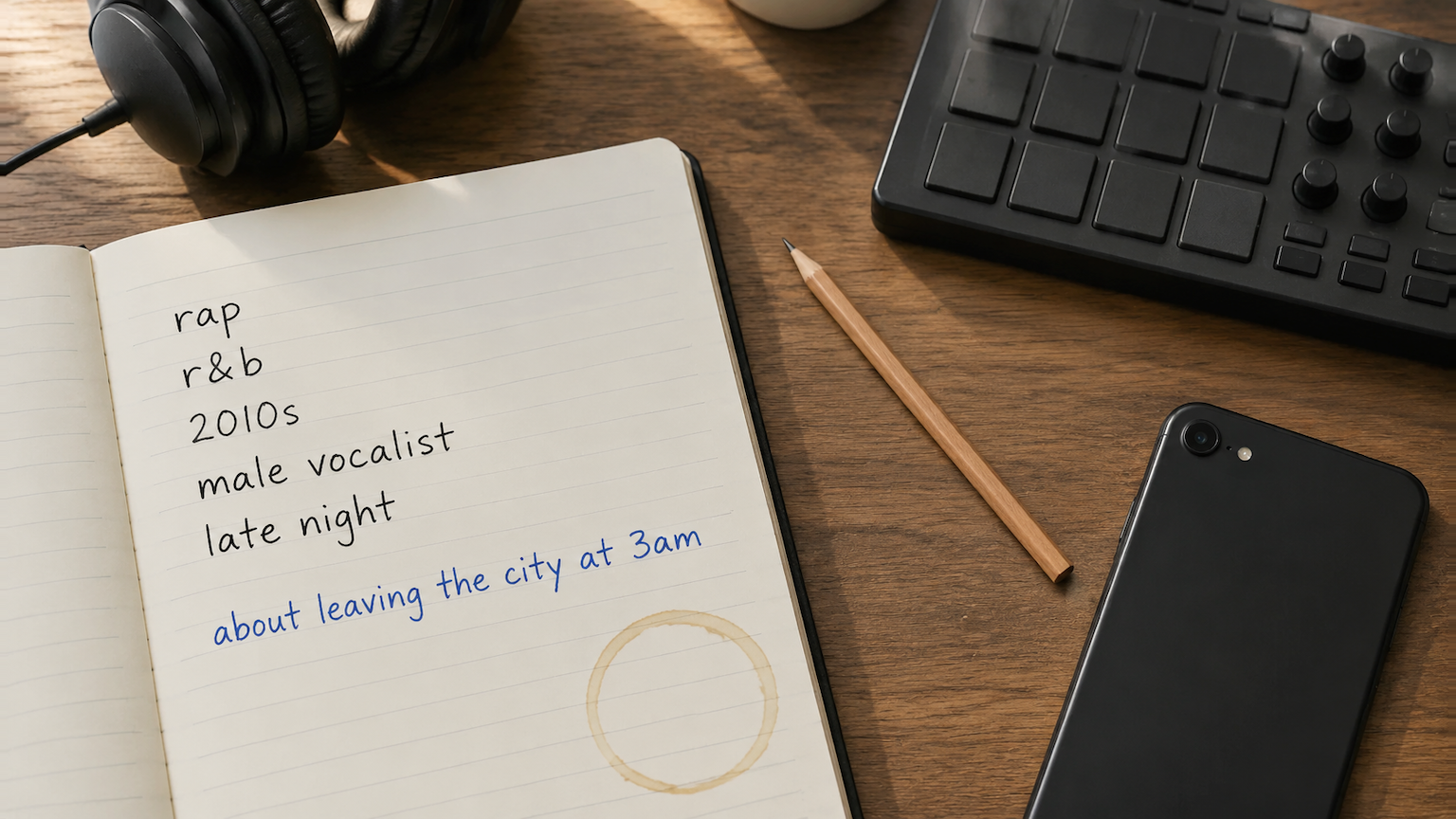
Tags you type come back as sent, so leave Style empty to learn new words. Then you can drop the name entirely and write 2020s, rap, contemporary r&b, canadian rap in the Style field. That gets you the same lane without a real person's name anywhere in your project, which is what you want when the track goes public.
Why Treblo is worth trying as an AI music generator with vocals
- A full song from one description. Treblo writes the lyrics, picks the structure and returns one finished song with vocals per request.
- An Instrumental switch. Turn it on and you get the same kind of track with no singing.
- Song details, all optional. Style tags, your own lyrics, styles to avoid and a title. Leave them empty and Treblo decides.
- A length you can aim for. A separate length control sits next to the Instrumental switch. On Auto the song picks its own length, or you pick a target from 1:00 to 4:30 in 30 second steps. The song lands close to it, not always exactly on it.
- Playback before it finishes. The song starts streaming while the final file is still being produced. In our two tests the stream was ready in under half a minute.
- Synced lyrics. For vocal songs, the lyrics follow the audio word by word, and you can tap a line to jump to that part of the song.
- A title if you skip one. Our two test songs came back named "Off The Grid" and "Leave The City" without us typing a title.
- Flat pricing. At the time of writing a Treblo song costs 34 credits per request, the same as a V6 request. Prices can change, so check pricing for the current rate.
You can also run Treblo from an AI agent through the Kubeez MCP server, with the same description, style, lyrics and instrumental options.
Tag tips: plain style words work best
Treblo only takes style tags from its own vocabulary, and that vocabulary is not published. If you send a tag it does not know, Treblo refuses the whole request.
Kubeez handles that for you: the request is sent again without the refused tags, and their words are added to your description, so you still get your song. Two exceptions: with your own lyrics plus some accepted tags, refused words are dropped (Treblo will not take a description, tags and lyrics together), and refused words in the avoid styles field are dropped too.
In practice:
- Use short genre, era and voice words as tags.
rap,pop rap,contemporary r&b,2010s,male vocalist,female vocalist. - Put tempo, key and mood in the description. Tags like
100 BPM,A minorormale vocalswere refused in real requests. Write "around 100 BPM, in a minor key, slow build" as a sentence instead. - Copy the tags Treblo gives back. They are words the engine already accepts.
- Leave Style empty when you are unsure. Treblo infers its own tags from the description, and you can borrow them afterwards.
Copyable prompts for Treblo
Paste these into the description on the AI music generator or straight into Kubeez Music, then adjust.
Late night R&B
A slow, moody R&B song about texting someone you should not text at 2am. Soft electric piano, deep sub bass, airy female vocals, sparse drums, intimate and close.
Summer pop
An upbeat summer pop song about a road trip with friends. Bright guitars, handclaps, a big singalong chorus, warm male vocals, feel good and nostalgic.
Cinematic instrumental (Instrumental on)
A slow building cinematic piece for a product reveal. Low strings, felt piano, distant percussion that grows into a wide, warm final section.
The artist style pattern
A [mood] [genre] song in the style of [artist], about [topic]. [Two or three sound details.]
For example: "A reflective late night rap and R&B song in the style of [artist], about outgrowing your hometown. Muted drums, warm keys, half sung hooks." Then read the tags Treblo returns and move those words into Style for your next takes, without the name.
Use it responsibly
A style reference is one thing. Passing a track off as a real artist is another. Presenting the result as that artist's work, or releasing something meant to sound like a real person's voice, can get a release taken down, or worse.
A short routine before you publish:
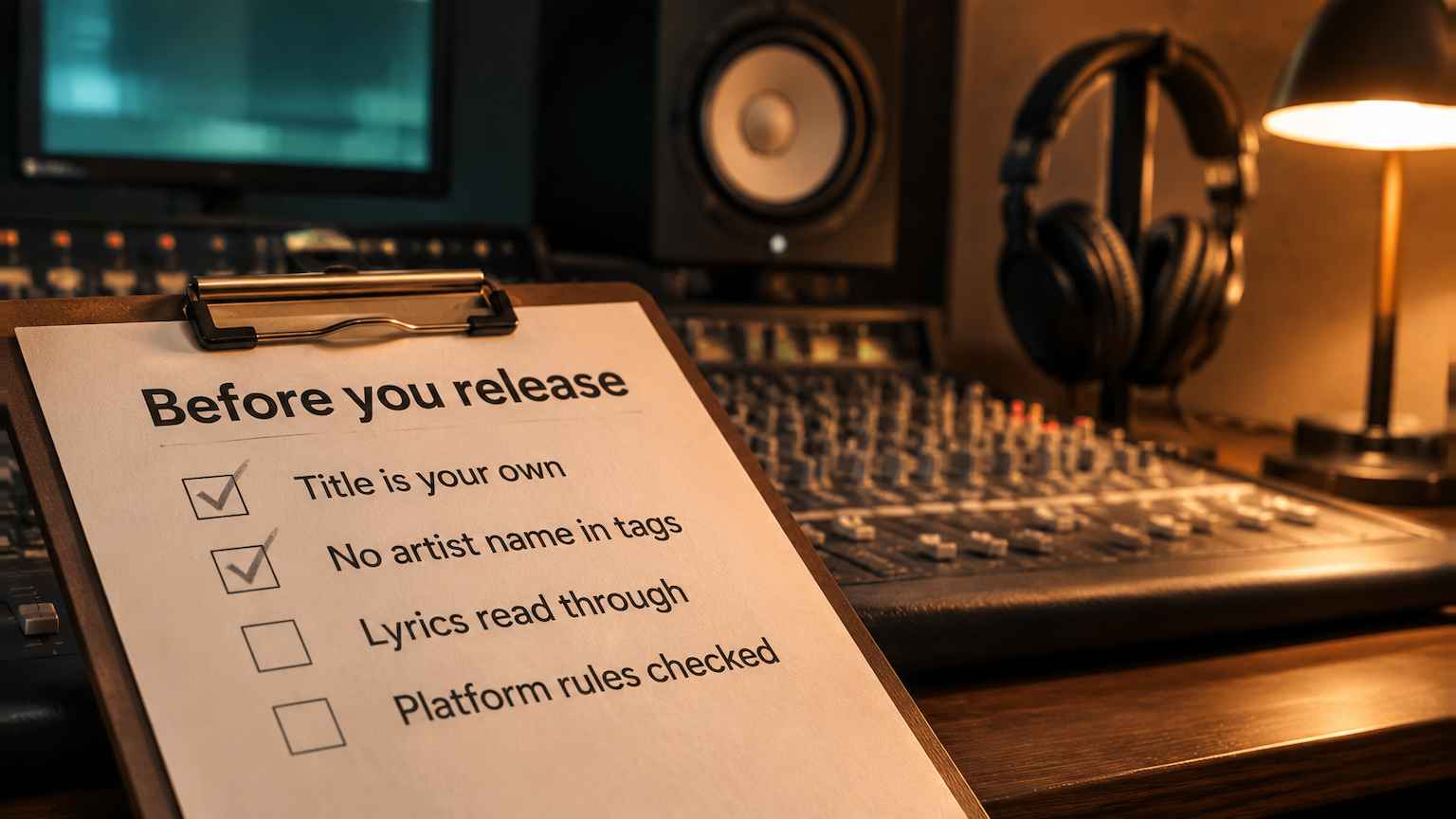
- Give it your own title and artist name. Never put the referenced artist's name in the title, the artist field, the cover or the description.
- Clean the tags. Treblo's tags often include the artist's name. Remove any real name before you upload.
- Read the lyrics. Treblo writes them, and in a few earlier runs they mentioned the artist by name. Edit or regenerate before you release.
- Do not suggest a feature or an endorsement. No "feat.", no "type beat by", nothing that implies the artist made or approved it.
- Check the rules where you publish. Streaming services, distributors and social apps each have their own rules on AI music and on content that imitates real artists.
This is practical advice, not legal advice.
Treblo or V6: which music model to pick
Kubeez has two engines for songs with vocals: Treblo and the V6 family (V6, V6 Wild and V6 Mini). At the time of writing a request on either costs 34 credits.
Pick Treblo when:
- You want to steer with an artist reference or with plain genre and era tags.
- You want synced, word by word lyrics while the song plays.
- You want to aim for a length, or you like to start listening while the song is still finishing.
Pick V6 when:
- You want more than one take per request. In our records a V6 request usually comes back with two songs, while Treblo returns one.
- You want to save a voice or a style as a persona and reuse it on later songs. Personas work on the V6 family, not on Treblo.
- You want a bolder sound (V6 Wild) or a quicker, lighter run (V6 Mini).
We have not tested artist names on V6. Describing the sound (genre, era, voice, instruments) works on both engines and is the safer habit anyway. If what you need is an instrumental at an exact length, for example a 30 second bed under a voiceover, use Sonilo in the same music page, which is billed per second.
For a walkthrough of the music page and agent workflows, see creating songs on Kubeez with the UI and MCP. For soundtracks under video, see AI music generation for your videos.
FAQ
Can I make a song that sounds like a specific artist with AI?
On Kubeez, Treblo accepts an artist's name as a style reference and writes in that direction: genre, era and general feel. There is no voice upload or voice cloning option, you steer it with words only, and the result is a new song, not that artist's work. Never present it as the real artist.
Why did some of my style tags end up in the description?
Treblo only takes tags from its own vocabulary. When it refuses one, Kubeez sends the request again without that tag and adds its words to your description, so you still get your song. Use short genre, era and voice words as tags.
How much does a Treblo song cost on Kubeez?
At the time of writing, 34 credits per request, which returns one song. Credit prices can change, so check the pricing page. You need an account to generate, and new accounts get a one time welcome credit grant.
Can I use Treblo for instrumentals?
Yes. Turn on Instrumental and Treblo returns the same kind of track with no vocals. For an instrumental at an exact length, Sonilo is the better fit.
Is it legal to release a song made in the style of an artist?
It depends on how you present it and where you publish. Do not use the artist's name in your release, do not imitate their voice, and check the rules of your distributor and the platforms you upload to.
Dex writes the Kubeez guides and makes every example with the same tools you use.